Built by fish keepers.
For fish keepers.
Tank Logic is a free, independent aquarium resource. No paywalls, no fluff — just accurate tools and honest guides — just accurate tools and honest guides built by people who actually keep fish.
Demystifying aquarium math, so the maths never kills a fish.
Almost every avoidable failure in this hobby comes down to numbers nobody explained properly: how much water a tank actually holds, how much bioload a filter can really process, how many fish a footprint can support. Get those numbers wrong and the consequences arrive on a biological schedule — ammonia doesn’t negotiate.
Tank Logic exists to make those numbers effortless. Every calculator is built to give you a clear, accurate, instantly-usable answer — in litres and gallons, centimetres and inches — so you can make stocking and setup decisions with the confidence of someone who’s done the maths, without doing the maths.
No paywalls. No accounts. No affiliate links, no sponsored content, no e-commerce clutter — the site is funded entirely by display advertising. See our advertising disclosure for the details. Just tools that work.
Curious who’s behind all this? Meet Sid →
Because the inch-per-gallon rule deserved to be retired.
Tank Logic is an independent, data-driven project built by a long-time aquarium hobbyist who also happens to write software — born from the gap between how fishkeeping is usually taught and how aquariums actually behave.
Most stocking advice still leans on linear rules of thumb — the infamous “one inch of fish per gallon” chief among them. It’s a rule that treats a slim, mid-water tetra and a chunky, waste-heavy pleco as interchangeable, ignores filtration entirely, and says nothing about whether a fish has the swimming terrain it needs. It survives because it’s easy, not because it’s right.
Our calculators were built to move past that trap: dynamic, multi-variable tools that weigh bioload capacity, filtration performance, and swimming terrain requirements — the factors that actually decide whether a stocking plan thrives or crashes. The same philosophy runs through everything here, from the nitrogen-cycle guides to the genetics calculator: model the biology, not the folklore.
And it’s grounded in real tanks. The fishroom behind this site has run planted Walstad setups, unheated cold-water systems, and an active bristlenose pleco breeding project for over six years. Every photo on the site is from those tanks. When a guide says something works, it’s because it worked — and where something failed, we say so.
Lightweight, fast, and free. Permanently.
Tank Logic is built as plain, fast, dependency-light web tooling — no app installs, no accounts, no trackers beyond the basics, nothing between you and the answer. Pages are designed to load quickly on any phone, anywhere in the world, on any connection.
Every calculator and guide on this site is free, and will stay free, for the global hobbyist community. If a tool here helps one more tank get cycled properly before the fish go in, it’s done its job.
Practical, experience-backed guidance.
We publish detailed guides on every aspect of freshwater fishkeeping — from setting up your first tank to breeding specialised species. Every guide draws on hands-on experience from our own fishroom, not recycled forum posts or AI-generated filler. When we recommend a filtration approach, a stocking combination, or a water parameter target, it is because we have run that setup ourselves and observed the results over months, not because we read it somewhere and passed it along.
Our content library has grown to over 124 guides covering tank cycling, water chemistry, fish stocking, planted tanks, the Walstad method, nano cichlid care, shrimp breeding, disease identification, equipment selection, and species-specific care sheets for 63 freshwater species. Each guide runs between 1,500 and 3,500 words and includes practical tables, quick-reference stats, and links to the relevant calculators and care sheets across the site.
We review and update guides regularly as the hobby evolves. Fishkeeping is not a static discipline — new species enter the trade, equipment improves, and our understanding of fish biology and water chemistry deepens. When readers point out an error or a better approach, we update the guide. The goal is a living resource that gets more accurate over time, not a static article published once and forgotten.
Tools that give you answers, not more questions.
Tank Size & Volume Calculator
Enter your tank dimensions and get the exact volume in gallons and litres instantly. Supports rectangular, bowfront, and hex tank shapes, with eight common size presets and smart follow-on recommendations for stocking, substrate, and water changes.
Fish Stocking Calculator
Raw volume is a starting point, not the whole picture. Our stocking calculator weighs bioload capacity, filtration performance, and swimming terrain — with the legacy inch-per-gallon figure shown only as a cross-check.
Walstad Soil Calculator
The Walstad method uses organic potting soil beneath a sand cap to feed plants directly from their roots — no CO₂, no liquid fertilisers. Our calculator tells you exactly how much soil and sand you need for your tank dimensions, with guidance on the Father Fish mineral layer variation and filtration recommendations.
Fish Care Database
Care sheets for 36 freshwater fish and invertebrate species, covering water parameters, temperament, diet, tank size requirements, and compatibility notes. Designed to be scanned quickly at a glance rather than read as an essay.
We take accuracy seriously.
Every calculator on Tank Logic uses established formulas or methods. The tank volume calculator uses straightforward geometric volume calculations. The stocking calculator weighs swimming terrain (the surface-area method) alongside bioload and filtration modifiers, with literature-based species sizes; the legacy inch-per-gallon figure is displayed only as a rough cross-check. The Walstad soil calculator follows the methods set out in Diana Walstad's Ecology of the Planted Aquarium and the practices popularised by the Father Fish YouTube channel.
Our guides are written by people who have actually kept aquariums and made the mistakes beginners make. We cross-reference our information against established aquarium resources, academic literature where relevant, and the broader fishkeeping community.
That said, we are not infallible. If you spot an error — in a calculation, a recommendation, or a care sheet — please tell us. We will investigate it and update the content if needed, and we credit corrections where appropriate.
Display advertising. Nothing else.
Tank Logic is supported by display advertising through Google AdSense. When you browse the site, you may see advertisements in certain areas of the page. These ads are served by Google and help cover our hosting and development costs. We are currently in the AdSense approval pipeline; once approved, we will run AdSense's auto-ads feature exclusively to start, then layer in selective manual placements once we have baseline data. Once the site reaches Mediavine's 50,000-sessions-per-month threshold, we plan to apply for Mediavine's premium ad management. The full roadmap is on our advertising disclosure page.
Because we are funded entirely by the ad network rather than by any brand or retailer, we have no financial incentive to recommend one product over another. There are no affiliate links anywhere on this site, no sponsored content, no reviews written in exchange for free product, and no commercial relationships with any manufacturer or retailer. The guides and calculators are written solely based on what we believe is best for the reader.
If you find Tank Logic useful, the most helpful thing you can do is share it with someone new to the hobby. Word of mouth is how independent resources like this survive.
Get in touch
Questions, corrections, tool suggestions, or just want to tell us about your tank? We read every message.
Go to contact pageEverything in that tank “fit.” It still fell apart.
A few years back I set up what was meant to be my perfect little ecosystem — a self-sustaining tank I could actually breed from and maybe make a bit of money off. The plan was tidy: a colony of red cherry shrimp working the bottom, fast-growing stem plants I could trim and sell, four white cloud minnows, mystery and rabbit snails turning the substrate over, my bristlenose plecos, and a few guppies for a bit of colour. On paper it was a nicely balanced community. Every fish “fit.”
The guppies were the first crack. They bred the way guppies do, kept getting bigger, and started nipping at my stem plants until they looked half-chewed. Worse, every batch of baby shrimp that turned up got picked off before it had a chance — so the colony I was counting on to grow itself never really got going. (I ended up writing that whole mess up in why your guppies keep dying.) So I started giving guppies away to claw the tank back.
Then I made the mistake that really did it. I had three adult bristlenose and couldn't keep two males in there together, so I rehomed one — and to fill the gap I brought in a pair of African cichlids. Going on size alone, everyone still “fit.” In reality those two slowly took the tank apart. My bristlenose actually spawned somewhere in the middle of it all, but I haven't seen one of that fry since. I gave the mother away as well, figuring I'd reset and start the breeding project properly from scratch.
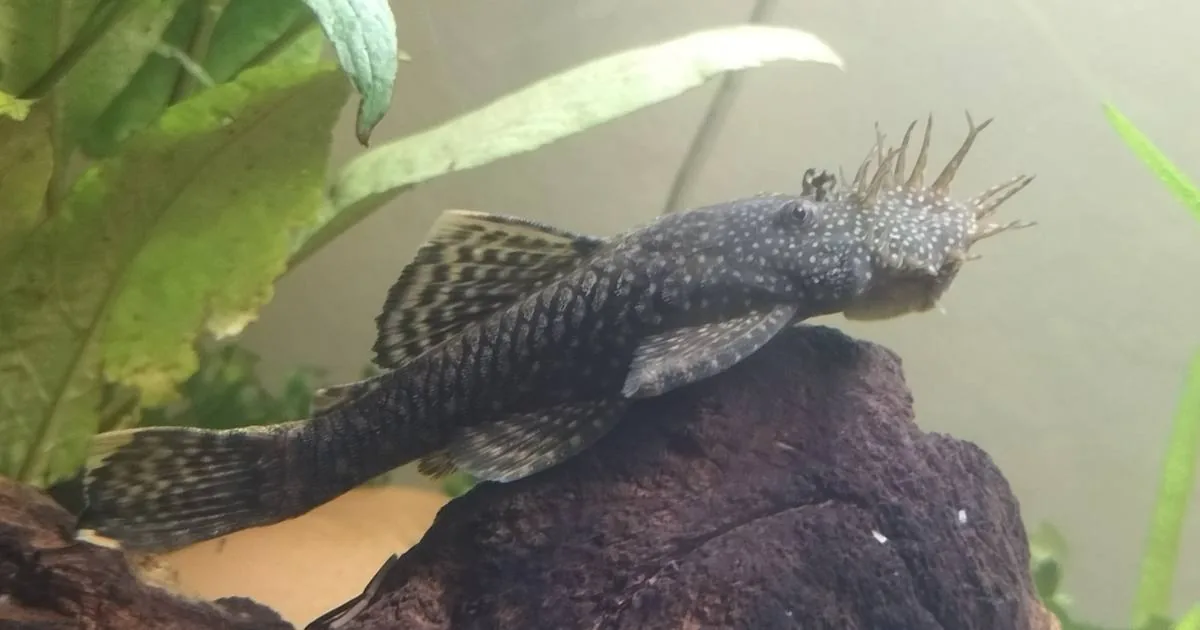
The last fish standing was my big common bristlenose male — Hank — sitting flat on the bottom while those two cichlids cruised around him like he wasn't even there. I still miss that daft fish. That tank taught me more than any rule of thumb ever could: it's never just whether fish fit by the inch. It's who eats who, who eats whose fry, who needs what kind of water, and how much waste the whole lot actually puts out. A two-minute stocking check would have talked me out of those cichlids before I ever bought them.
That tank was one chapter in my fishkeeping journey since 2020. My fishroom now is a mix of things I've gone properly deep on — a bristlenose breeding project I'm working toward albino longfins, a few Walstad-method tanks running on nothing but soil, plants and patience (no CO₂, no dosing), and unheated cold-water setups that just tick along through the seasons. And the honest reason these calculators exist is that I got sick of doing the same maths by hand for every stocking plan and substrate build. So I made the tools I wish I'd had: 7 free calculators that weigh bioload, filtration and real swimming room instead of parroting a volume rule, plus 124-plus guides — and every default in them comes from a real tank in my house, Hank's included.
No signups, no paywalls, no “premium” nonsense — just what I'd tell you if we were stood in front of the tanks at your local fish shop.