Before You Stock: Know Your Limits
A 10-gallon tank holds roughly 8–9 gallons of actual water once you account for substrate, decorations, and the fact that tanks aren't filled to the very brim. In bioload terms that supports roughly one small school of nano fish. The swimming-terrain check (1 inch (2.5 cm) of fish per 12 in² (77 cm²) of surface) lands in the same place for a standard 20×10 inch (51 × 25 cm) footprint — and the modest footprint, more than raw volume, is the real constraint.
The golden rule for small tanks: less is more. Understocking a 10-gallon is far easier to maintain than overstocking it. Small tanks experience water quality swings faster than large ones, and there's no room for error. Always cycle the tank fully before adding any fish.
Goldfish (produce huge amounts of waste), common plecos (grow to 18"+), tiger barbs (aggressive in small groups), cichlids (most species need more space), and any fish labelled "grows large" at the fish store. If in doubt, check the adult size, not the size in the tank.
1. Betta Fish — The Classic Solo Star
A single male betta is the most popular choice for a 10-gallon tank — and for good reason. Bettas are stunning, interactive, and perfectly sized for the space. A 10-gallon gives a betta far more room than the tiny bowls they're often sold in, allowing for proper filtration, heating, and enrichment.
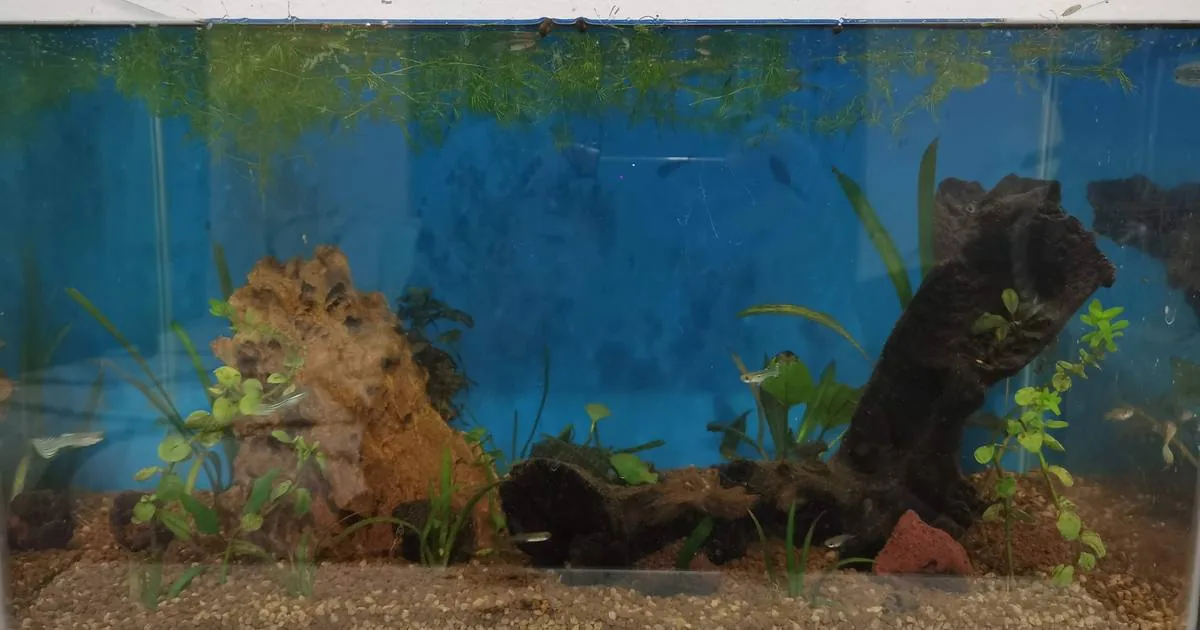
Keep only one male betta per tank — they will fight to the death if housed together. Female bettas can sometimes be kept in groups of 5+ (called a sorority), but this requires a densely planted tank with plenty of hiding spots and is not recommended for beginners. Bettas can coexist with peaceful bottom dwellers like pygmy corydoras or nerite snails, and many do well with a colony of cherry freshwater shrimp — though individual personalities vary.
Bettas are labyrinth fish — they breathe air from the surface. Keep the water level 1–2 inches (2.5–5.1 cm) below the tank rim so they can reach the surface easily, and avoid strong currents from the filter which exhaust them.
2. Neon Tetras — The Classic Schooling Fish
Six neon tetras in a planted 10-gallon is one of the most beautiful and beginner-friendly setups you can create. Their iconic blue-and-red stripe catches light brilliantly, and watching a tight school move together is endlessly satisfying. At 1.5 inches (3.8 cm) each, a school of six uses 9 inches (23 cm) of your stocking budget — bringing a 10-gallon right to a comfortable limit on its own.
Neons prefer slightly soft, acidic water and feel most secure with dense planting or floating plants that dim the light. They're sensitive to ammonia spikes — don't add them to an uncycled tank. For a peaceful combination, pair six neons with a small group of pygmy corydoras at the bottom.
3. Ember Tetras — The Nano Gem
Ember tetras are tiny — just 0.8 inches (2 cm) — which means you can keep a large, impressive school in a 10-gallon without overstocking. Ten to twelve embers gives you a stunning, glowing orange cloud of fish for under 10 inches (25 cm) of stocking. They're also extremely hardy, tolerating a wide range of temperatures and pH levels.
Unlike neons, embers are rarely seen in big box stores but are commonly available online or at specialist fish shops. They're one of the best kept secrets in nano fishkeeping — beautiful, peaceful, easy to breed, and almost indestructible once established in a cycled tank.
4. Guppies — Colourful and Hardy
Guppies are among the hardiest and most adaptable freshwater fish available. Males display spectacular fan tails in every colour imaginable, while females are larger and plainer. In a 10-gallon, keep a trio of males (no females) to avoid population explosions — guppies breed prolifically and a 10-gallon can't support multiple generations.
Three male guppies in a 10-gallon with some live plants is a low-maintenance, beginner-perfect setup. They're tolerant of a wide range of water conditions, eat virtually anything, and are endlessly active. Add a small bristlenose pleco (just one — they reach 4–5 inches (10–13 cm)) and you have a complete, self-maintaining community.
5. Pygmy Corydoras — The Perfect Bottom Dweller
Pygmy corydoras are the smallest corydoras species — just 1 inch (2.5 cm) — making them ideal for 10-gallon tanks where larger corydoras (2.5+ inches (6 cm)) would be too bulky. They're schooling fish that must be kept in groups of at least 6, and unlike most corydoras they spend time throughout the water column rather than just at the bottom.
A group of 6 pygmy corydoras pairs beautifully with neon tetras or ember tetras in the middle and upper levels. They're clean, peaceful, and entertaining to watch as they zip around in tight formations. Always provide a soft substrate (fine sand or smooth gravel) — their delicate barbels are damaged by sharp-edged gravel.
6. Cherry Shrimp — The Clean-Up Crew
Cherry shrimp aren't fish, but they're one of the best additions to a 10-gallon tank. They graze constantly on algae and biofilm, helping keep the tank clean. A colony of 10–20 shrimp adds almost no bioload and brings constant activity — watching females carry eggs, juveniles graze on plants, and adults pick at algae patches is genuinely captivating.
Cherry shrimp are best kept in a species-only tank or with very peaceful fish that won't eat them. Neon tetras and ember tetras generally leave adult shrimp alone but may pick off juveniles. Bettas should not be housed with shrimp — most bettas will hunt and eat them. For a shrimp-forward tank, pair them with pygmy corydoras or otocinclus and enjoy a thriving cleanup crew.
Recommended 10-Gallon Stocking Combinations
A list of good fish doesn't tell you what actually lives together. So here are the three 10-gallon setups I'd genuinely run — each one is a complete plan, and I've spelled out why it holds together instead of just handing you a species list. The trick in a small tank is using different zones (top, middle, bottom, glass) so nothing's fighting for the same space, and keeping the bioload low enough that your filter never struggles.
Plan 1 · The Peaceful Nano Community
8–10× ember tetra (or chili rasbora / neon tetra) · 1× nerite snail · optional small cherry-shrimp cleanup crew
Why it works: ember tetras are tiny — barely 2 cm — so a whole shoal adds almost no waste, and they hold the middle of the tank where you actually see them. The nerite grazes algae off the glass and physically can't overpopulate (they won't breed in freshwater), and a few cherry shrimp pick over the bottom. Three different zones, one calm temperament, everyone likes the same warm, slightly soft water. It's about the most beginner-proof tank I can think of — if you've never kept fish, start here.
Plan 2 · The Betta, Done Right
1× male betta · 6× pygmy corydoras · 1× nerite snail
Why it works: pygmy cories are quick, peaceful, and stick to the bottom, so they stay out of the betta's way while he patrols the top and middle. Same warm, still water suits both. Notice what's not here — shrimp. I used to try betta-plus-shrimp and lost the shrimp every time; most bettas treat them as snacks. One honest warning: betta temperament is down to the individual fish. Most are fine with calm tankmates, but some won't tolerate anyone. Have a spare tank or a backup plan before you mix, just in case yours turns out to be a tyrant.
Plan 3 · The Shrimp Colony (the actually self-sustaining one)
10–15× red cherry shrimp to start · 1–2× nerite snail · no fish
Why it works: this is the build I wish I'd run first. My own “self-sustaining” tank fell apart for one simple reason — I kept fish in with the shrimp, and the guppies ate every batch of babies before the colony could grow. Take the fish out of the equation and a cherry colony genuinely runs itself: they breed readily, graze biofilm and algae, add next to no waste, and in a planted 10-gallon you'll go from a dozen to a few hundred over a year. If your goal is to breed something — for the fun of it or a bit of profit — this is the setup, not fish-plus-shrimp. There's more detail in my freshwater shrimp guide.
Don't add all your fish on the same day, even in a cycled tank. Add one group at a time, wait a week, test your water, then add the next group. This gives your filter bacteria time to adjust to the increased bioload without crashing.
Fish I'd Never Put in a 10-Gallon — and Why
A 10-gallon looks roomy in the shop and fills up fast. Almost every early disaster I had came from stocking by “it fits right now” instead of “will it still fit in six months, and can it actually live with the others?” These are the ones I'd talk you out of:
- Common & bristlenose plecos. Sold as cute 2-inch algae crew, they grow to 4–6 inches, and a stocky pleco puts out roughly ten times the waste of a slim tetra the same length. I breed bristlenose and love them — but even my common male, Hank, needed far more tank than 10 gallons. Right fish, wrong box.
- Goldfish, fancy or common. Cold-water, heavy waste producers, and they get big. A single goldfish overwhelms a 10-gallon's filter — they want a large tank or a pond, not a nano.
- Guppies, if you ever want shrimp to breed. Guppies are great fish, but in a shrimp tank they hoover up every batch of shrimplets and overpopulate themselves on top of it. That's the exact reason my own “self-sustaining” tank stopped sustaining itself. Pick one project or the other — not both.
- African cichlids & other aggressive or territorial fish. I once added a cichlid pair to a peaceful community to “fill it out,” and they slowly dismantled the entire tank. In a 10-gallon there's nowhere for anyone to flee to — aggression has no relief valve.
- Anything sold small that grows big — bala “sharks,” iridescent sharks, tinfoil barbs, common plecos. The tank label says 3 inches; the fish says 12. If you don't know the adult size, look it up before you pay.
- Fast, nippy schoolers that need length — tiger barbs, full-size danios. They want swimming room a two-foot tank can't give, and a cramped, bored barb is a fin-nipping barb.
Before you buy anything, run the combo through the stocking calculator and look up the adult size and temperament in the fish database. It's the cheapest fish insurance there is — and it's exactly the step I skipped on the tank I lost.
Setup Tips for a 10-Gallon
- Filter: Use a sponge filter or a hang-on-back (HOB) filter rated for 20–30 gallons. A filter rated exactly for 10 gallons won't have enough media to handle a stocked tank. Sponge filters are especially good for shrimp and fry.
- Heater: A 50-watt adjustable heater keeps a 10-gallon stable. Avoid preset heaters — they often run hotter than advertised. Aim for a consistent 26°C for tropical fish.
- Substrate: Fine sand or smooth gravel for corydoras. Nutrient-rich substrate (like Fluval Stratum or ADA Aqua Soil) if you plan a planted tank.
- Plants: Java moss, anubias, java fern, and Amazon sword all work brilliantly in 10-gallons. Dense planting reduces stress, provides hiding spots, and improves water quality by absorbing nitrate.
- Lid: Essential. Bettas, guppies, and many tetras are known jumpers. A close-fitting lid prevents losses.
Summary
A 10-gallon tank is small enough to be manageable but large enough to support a beautiful, diverse community. The key is choosing appropriately sized fish, keeping schools together, and never overstocking. Start with a single species or combination from this list, get the water stable, and enjoy the hobby — a well-kept 10-gallon is one of the most rewarding aquariums you can own.
Check Your Stocking Level
Use our free stocking calculator to make sure your chosen combination fits your tank safely.
Open Stocking Calculator →Recommended Product
Amazon affiliate link — we may earn a commission at no extra cost to you.
10 Gallon Tank Product
Best for: 10 gallon tank owners
A recommended product for 10 gallon aquarium setups — selected based on real fishroom experience.