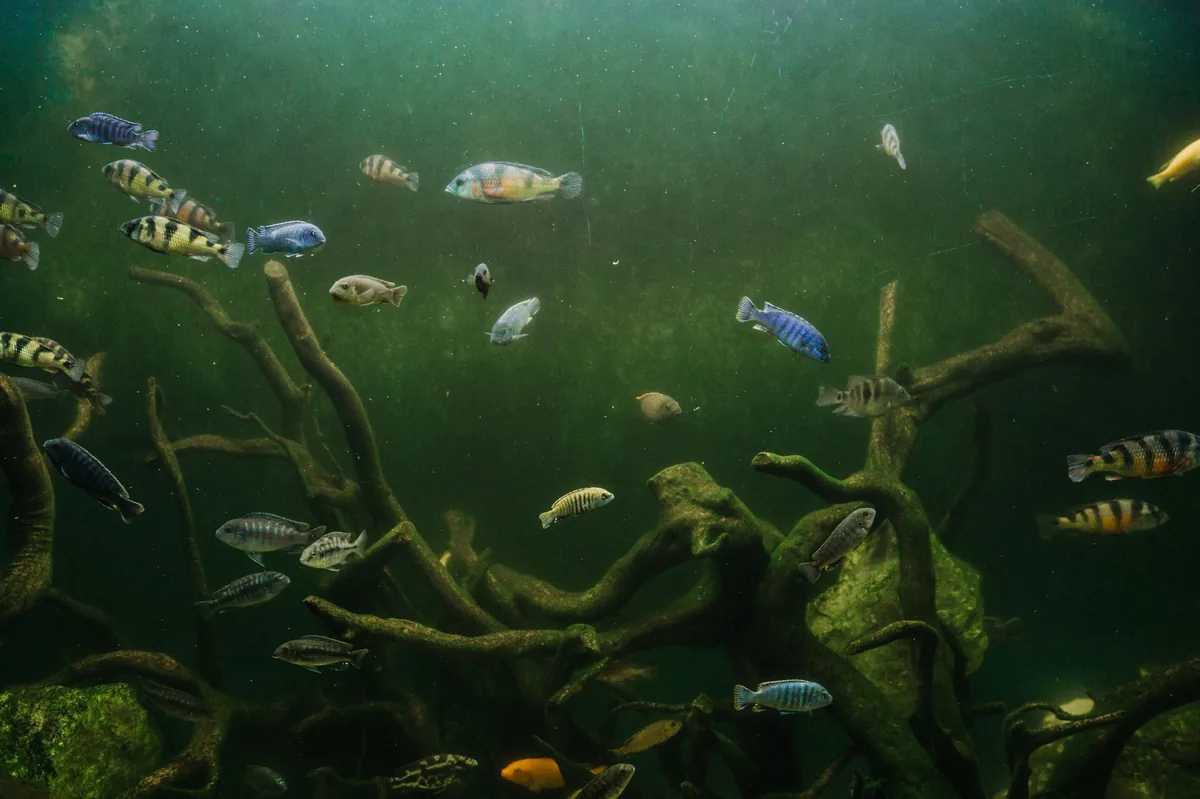
Nano cichlids are the gateway drug to the cichlid hobby. They give you the personality, the parental care, and the territorial drama of big cichlids — compressed into a fish that fits in a 20 gallon long. I have kept Apistogramma, rams, shell dwellers, and kribensis side by side in my fishroom for the last four years, and they are the fish I check on first every morning. This hub is the entry point for everything nano cichlid on Tank Logic. Read it once, then dive into the species-specific guides linked at the bottom.
Match the species to your tap water, not the other way around. Apistogramma and rams want soft, acidic water; shell dwellers want hard, alkaline water; kribensis sit somewhere in the middle. Fighting your tap water with reverse osmosis, peat, or chemical buffers in your first year will kill more fish than it saves. Test your tap, pick the species that fits, and you have eliminated 80% of the common failures before you buy a single fish.
Why Nano Cichlids?
Nano cichlids give you the cichlid experience — pair bonding, fry care, territorial disputes, individual personalities — without the 75 gallon tank and the constant filtration arms race that comes with Oscars, Jack Dempseys, and Central American bruisers. A single pair of Apistogramma cacatuoides in a 20 gallon long is more interesting to watch than a 125 gallon of community fish, and that is not a knock on community tanks. The behaviours are richer.
They are also genuinely small fish. Adult Apistogramma max out around 7–8 cm, German blue rams at 6–7 cm, Bolivian rams at 8 cm, shell dwellers at 4–5 cm, and kribensis at 8–10 cm. That puts every fish in this guide comfortably in a tank under 40 gallons, with several species viable in a 10 or 20. The bioload is modest. The equipment requirements are modest. The only thing that is not modest is the personality.
What trips people up is the assumption that "small cichlid" means "easy cichlid." It does not. Dwarf cichlids are more sensitive to water quality than the big hardy Central Americans, they have specific water chemistry preferences that you cannot ignore, and they will absolutely murder each other if you stock them wrong. The skill floor is higher than tetras and guppies. Treat that as a feature, not a bug — the fish reward the work.
Species Overview
There are four groups of nano cichlids that make up 95% of what you will see in the hobby. Each fills a different niche, and each has a dedicated care guide on this site. Here is the snapshot:
| Group | Adult size | Min tank | Water | Difficulty |
|---|---|---|---|---|
| Apistogramma (cacatuoides, agassizii, borellii) | 5–8 cm | 20 gal | Soft, acidic (pH 5.5–7.0) | Medium |
| Ram cichlids (German blue, Bolivian) | 6–8 cm | 20 gal | Warm, soft (pH 6.0–7.0, 27–29°C) | Medium |
| Shell dwellers (N. multifasciatus, brevis, occelatus) | 4–6 cm | 10 gal | Hard, alkaline (pH 7.8–8.5) | Easy |
| Kribensis (Pelvicachromis pulcher) | 8–10 cm | 20 gal | Neutral (pH 6.5–7.5) | Easy–Medium |
Apistogramma are the South American dwarf cichlids. The genus has 90+ described species, but the hobby lives on about ten. Apistogramma cacatuoides (the cockatoo dwarf cichlid) is the most common, the hardiest, and the one I recommend to anyone keeping Apistogramma for the first time. They come in a half-dozen colour strains — double red, triple red, orange flash — and a dominant male in breeding colour is one of the prettiest freshwater fish you can keep. The full guide is here.
Ram cichlids are split into two species: the German blue ram (Mikrogeophagus ramirezi) and the Bolivian ram (M. altispinosus). German blues are more colourful and far more demanding; Bolivians are drabber and nearly bulletproof. I recommend Bolivians to anyone whose tap water is not soft, and German blues only to keepers willing to commit to reverse osmosis water and a heater that holds 28°C without drift. The full guide is here.
Shell dwellers are the odd ones out. They come from Lake Tanganyika in Africa, not South America, which means hard alkaline water instead of soft acidic water. Neolamprologus multifasciatus is the smallest cichlid in the hobby at 4 cm, and a colony of 8–10 in a 10 gallon with sand and escargot shells is one of the most behaviour-rich tanks you can build. They breed constantly, they dig constantly, and they rearrange their shells the way bigger cichlids rearrange rocks. The full guide is here.
Kribensis (Pelvicachromis pulcher) round out the list. They are West African riverine cichlids, adaptable to neutral pH, and they have been in the hobby long enough that tank-bred stock is bulletproof. A pair in a 20 gallon is a classic beginner cichlid tank. The purple-and-yellow breeding female is iconic. They are not covered in a dedicated guide on this site yet — this hub and the stocking advice below are what you need until that page exists.
Tank Size Guide: 10, 20, and 40 Gallon
Nano cichlids scale with tank size in ways that are not obvious from the adult length of the fish. The fish might fit, but the territory structure has to fit too. Here is what each size actually buys you:
10 gallon — shell dwellers only
A 10 gallon is the realistic minimum for a single species: Neolamprologus multifasciatus. A colony of 8–10 adults with 15–20 escargot shells and a 3 cm sand bed turns a 10 gallon into the most active small tank in the hobby. Nothing else in this guide belongs in a 10. Apistogramma in a 10 gallon is a common recommendation on hobby forums, and it is wrong — they survive, but they cannot establish a proper territory and the male will batter the female to death inside a month.
20 gallon long — the South American sweet spot
A 20 gallon long (30 × 12 × 12 inches) is the minimum for Apistogramma, rams, and kribensis. The 30-inch footprint gives a pair enough room to split the tank into his-and-hers territories, which is the difference between a pair that breeds and a pair that ends with one fish dead in the corner. A 20 gallon tall is not a substitute — the 24-inch footprint is too short and the extra height is wasted on these fish, which live on the bottom.
40 gallon breeder — multiple pairs and tank mates
A 40 gallon breeder (36 × 18 × 16 inches) is where you can start mixing. Two pairs of Apistogramma, or a pair of rams with a school of tetras and a group of corydoras, or a small colony of shell dwellers alongside a Tanganyika rock-dweller like Julidochromis transcriptus. The 18-inch depth front-to-back matters more than people realise — it gives you room for two distinct territory zones with a no-man's-land between them.
Water Parameters
This is where nano cichlids lose 80% of new keepers. The four groups in this guide want two completely different water chemistries, and getting it wrong is the single most common reason for dead dwarf cichlids. Test your tap water for pH, GH, and KH before you buy any fish. The test takes ten minutes and saves you the cost of a dead breeding pair.
South American dwarf cichlids (Apistogramma, rams) come from soft, acidic blackwater tributaries of the Amazon and Orinoco. Ideal parameters are pH 5.5–6.8, GH 2–8 dGH, KH 1–4 dKH, temperature 24–29°C depending on species. German blue rams want the warm end (27–29°C); Apistogramma cacatuoides are happy at 24–26°C. If your tap water is liquid rock (pH 8, GH 15+), you will need to dilute with reverse osmosis water or pick a different species. Bolivian rams tolerate harder water than German blues but still prefer soft.
Shell dwellers come from Lake Tanganyika, which is essentially a liquid calcium carbonate battery. Ideal parameters are pH 7.8–8.5, GH 10–15 dGH, KH 8–12 dKH, temperature 24–27°C. Most tap water in North America and Europe is closer to Tanganyika parameters than to Amazon parameters — which is why shell dwellers are the easiest nano cichlid for the majority of keepers. If your tap is already pH 7.5+, you do not need to do anything special.
Kribensis are the compromise fish. They come from West African rivers that are soft but not acidic, and tank-bred stock has adapted to a remarkable range. They will breed at pH 6.5 or pH 7.5, GH 5 or GH 15. The pH affects sex ratio of the fry (lower pH favours females, higher pH favours males), which is a fun detail to play with once you are breeding them. For a first pair, just keep your tap water stable and they will be fine.
Stocking Combinations That Actually Work
These are combinations I have run myself or watched succeed in other fishrooms for at least a year. Each one respects territory, bioload, and water chemistry:
Plan 1: The 10 Gallon Shell Bed
10 Neolamprologus multifasciatus + 3 Nerite Snails
A single-species Tanganyika tank. The multis claim individual shells, dig the sand around them, and breed constantly. You will have fry in the tank within three months. Nerite snails handle algae without bothering the shells. No fish tank mates — a 10 gallon is the colony's territory and adding anything else is asking for trouble.
Plan 2: The 20 Long Apistogramma Harem
1 male + 3 female Apistogramma cacatuoides + 8 Green Neon Tetras + 6 Corydoras habrosus
The harem structure is how Apistogramma live in the wild. The male patrols the whole tank; each female claims a 15 cm territory around her cave. The green neons are mid-water dithers that make the Apistogramma feel safe; the dwarf corydoras work the sand without competing for the same territory. Plant heavily, break sight lines with driftwood, and provide three cave options (one per female plus a spare).
Plan 3: The 20 Long Ram Pair
1 male + 1 female German Blue Ram + 10 Ember Tetras + 6 Pygmy Corydoras
A focused ram tank. The pair claims half the tank each; the ember tetras occupy the mid-water and act as dithers; the pygmy corydoras work the sand. Use a sand substrate (rams sift sand through their gills — gravel damages them over time). Keep the temperature at 28°C for the rams; the tetras and corydoras will tolerate it. This is one of the most visually striking 20 gallon tanks you can build.
Plan 4: The 40 Breeder Community
1 pair Bolivian Rams + 1 pair Apistogramma cacatuoides + 15 Rummynose Tetras + 8 Corydoras sterbai + 2 Bristlenose Plecos
The 40 breeder gives you room to mix. The rams take the right side, the Apistogramma take the left, the rummynose school fills the mid-water, and the corydoras and bristlenose work the bottom. Use a piece of driftwood down the middle as a sight-line break. This is a higher-bioload tank — run a canister filter rated for 55 gallons and do 40% weekly water changes.
Plan 5: The Tanganyika 40 Breeder
12 Neolamprologus multifasciatus + 6 Julidochromis transcriptus + 4 Cyprichromis leptosoma
A proper Tanganyika community. The multis work the sand and shells; the Julies claim a rock pile at one end; the cyps school in the open water column above them. Hard alkaline water is non-negotiable — if your tap is soft, this tank is not for you. This is the most rewarding tank in this guide if you can commit to the water chemistry.
Common Mistakes That Kill Nano Cichlid Tanks
1. Mixing South American and African species in the same tank. One group wants pH 6.0, the other wants pH 8.0. There is no compromise pH that both thrive at — they both just survive, and "survive" with dwarf cichlids usually means no breeding, faded colours, and a shortened lifespan. Pick a continent and commit.
2. Keeping a single Apistogramma or ram in a community tank. These are pair-bonding fish. A single individual is a stressed individual. If you cannot house a pair (or a harem for Apistogramma), do not keep the species. I see people buy one German blue ram "for colour" and wonder why it hides for six weeks and then dies.
3. Adding rams to an uncycled tank. German blue rams are canaries in the coal mine. Trace ammonia that a tetra shrugs off will kill a ram in 48 hours. Cycle the tank for at least six weeks, confirm 0 ammonia and 0 nitrite on a liquid test kit, then add rams — and only then.
4. Using gravel substrate. Apistogramma, rams, and kribensis all sift substrate through their gills. Sharp gravel damages the gill filaments and sets up chronic bacterial infections. Use smooth sand — pool filter sand, play sand, or CaribSea Super Naturals. Shell dwellers need sand for digging; it is not optional.
5. Buying wild-caught fish for your first dwarf cichlid tank. Wild Apistogramma and wild German blue rams are stunning, sensitive, and often carrying parasites. Tank-bred stock is hardier, cheaper, and already adapted to aquarium life. Save wild-caught for your third or fourth dwarf cichlid tank, not your first.
6. Ignoring temperature requirements for German blue rams. GBRs want 27–29°C. Most community tetras want 24–26°C. Pushing the temperature down to "compromise" at 25°C stresses the rams and opens the door to ich and bacterial infections. If your tank cannot hold 28°C, get Bolivian rams or Apistogramma instead.
Tools and Species Guides
Use the stocking calculator to check bioload before you commit to any of the combinations above. For the species-specific guides, start here:
- Apistogramma Care Guide — full species & strains, harem structure, breeding, diseases
- Ram Cichlid Care Guide — German blue vs Bolivian, breeding, health issues
- Shell Dweller Care Guide — N. multifasciatus, colony setup, Tanganyika water
- Tank Size Calculator — verify the actual water volume of your tank
- Cycling Guide — non-negotiable before any dwarf cichlid goes in
Frequently Asked Questions
What is the smallest cichlid I can keep in a 10 gallon tank?
Neolamprologus multifasciatus, the shell dweller, is the smallest cichlid commonly available in the hobby. Adults reach 4–5 cm and a colony of 8–10 fits in a 10 gallon with sand and shells. No other cichlid is appropriate for a 10 gallon — Apistogramma and rams need a 20 gallon long minimum for the territory structure to work.
Are nano cichlids aggressive?
Dwarf cichlids are aggressive within their territory but not across the whole tank. A pair of Apistogramma in a 20 gallon will claim a 30 cm patch of substrate and defend it from intruders, including your hand during maintenance. Outside the territory they are peaceful. The aggression is concentrated, not constant — and it is part of what makes them interesting to watch.
Can I keep two different dwarf cichlid species together?
Only in a 40 gallon or larger with broken sight lines. In a 20 gallon, two dwarf cichlid species will fight for the same territory and one will lose. The exception is a Tanganyika tank where shell dwellers (bottom) and a small rock-dwelling Lamprologus like Julidochromis occupy different niches in the same water chemistry.
Do nano cichlids need special water parameters?
It depends on the species. South American dwarf cichlids (Apistogramma, rams) prefer soft, acidic water — pH 5.5–7.0, GH under 8. African shell dwellers from Lake Tanganyika need hard, alkaline water — pH 7.8–8.5, GH 10+. Kribensis tolerate a wider range. Test your tap water first and match the species to it, not the other way around.
What is the easiest nano cichlid for a beginner?
Shell dwellers (N. multifasciatus) are the easiest — they tolerate a wide range of hard water, breed constantly, and have simple tank-mate rules. Bolivian rams are the easiest South American dwarf cichlid — hardier than German blue rams and more forgiving of water parameter swings. Apistogramma cacatuoides are the easiest Apistogramma species if your water is already soft.