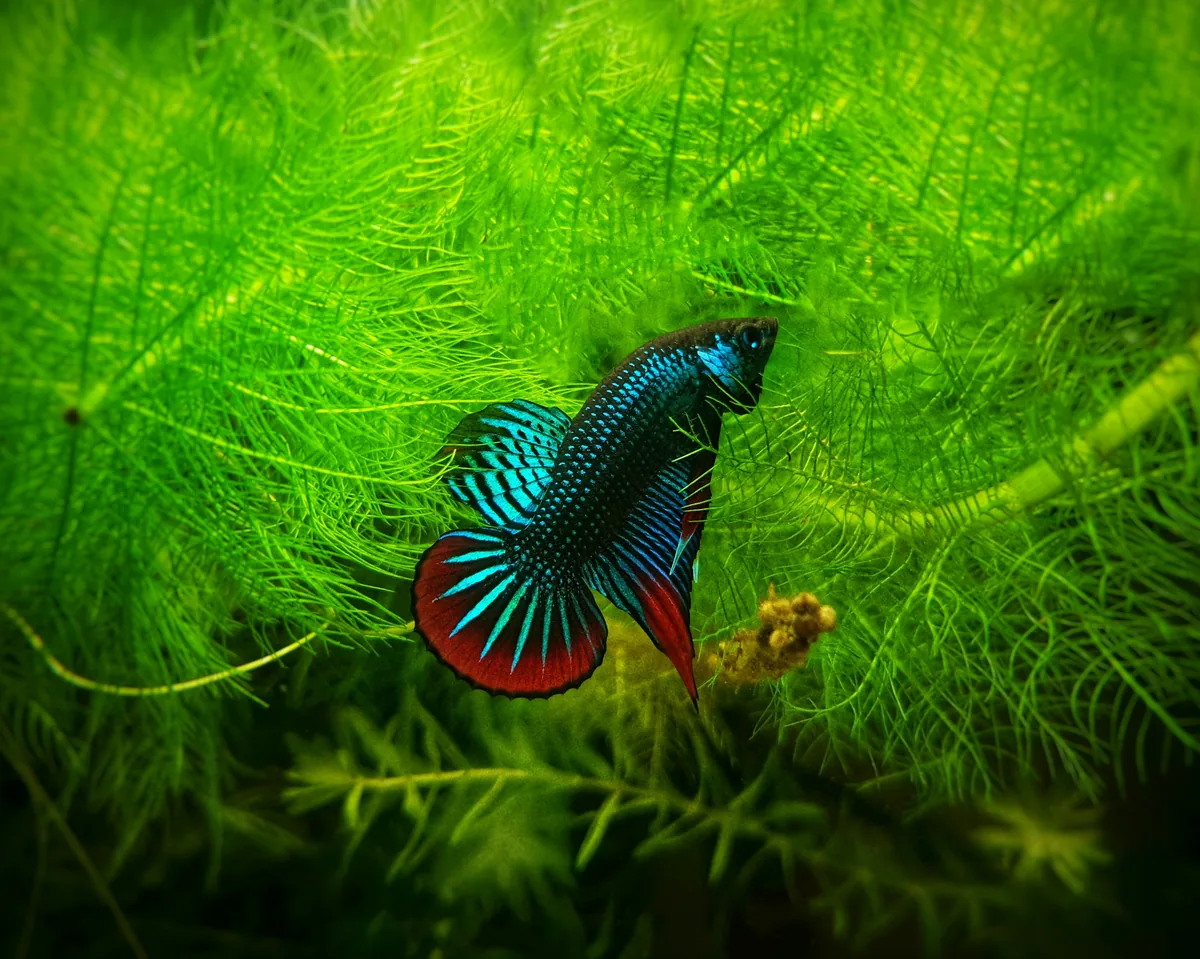
Quick Stats
| Adult Size | 6–8 cm |
| Minimum Tank | 5 gal (not a vase or 1-gallon bowl) |
| Temperature | 26–28°C (tropical — not room temp) |
| pH Range | 6.5–7.5 |
| Hardness (GH) | 4–15 dGH |
| Difficulty | Easy |
| Temperament | Semi-aggressive (males aggressive to other males; can be aggressive to tank mates) |
| Diet | Carnivore — betta pellets, frozen bloodworm, daphnia, brine shrimp |
| Schooling | Keep alone (one male per tank) or 1 male + female sorority (advanced) |
Tank Setup
The Betta splendens (the Siamese fighting fish) is the most popular aquarium fish in the world, and the myths around it are genuinely dangerous. The betta-in-a-vase setup, the betta-in-a-bowl setup, the “betta eats plant roots” setup — these are not neutral differences of opinion. They kill fish, slowly, over months. Here is the truth: bettas are tropical fish. They come from the warm shallow waters of Thailand, Cambodia, and Vietnam, where the temperature sits at 26–28°C year-round. A betta in an unheated bowl in a 20°C room is a chronically stressed, immunocompromised fish that will succumb to fin rot, velvet, or a bacterial infection within months. The labyrinth organ — the modified gill structure that lets bettas breathe atmospheric air — does not let them survive in polluted water; it lets them survive in oxygen-poor but otherwise clean water. That is the difference, and it matters.
A single male betta needs a minimum of 5 gallons (20 litres) of fully cycled, heated, filtered water. That is the floor, not the target — a 10 gallon is a better home and not much more expensive. Maintain water parameters within: temperature 26–28°C, pH 6.5–7.5, hardness 4–15 dGH. The pH range is wide because captive-bred bettas have been selected for tolerance over generations; they will live and breed at pH 7.5 and GH 12 with no issue. The temperature range is not negotiable. A 25-watt or 50-watt preset aquarium heater set to 27°C is the single most important piece of equipment in a betta tank — more important than the filter, more important than the tank itself. Without a heater, the betta is not actually being kept; it is being slowly killed.
Set up the tank with a gentle filter (sponge filter, air-driven corner filter, or a hang-on-back with the flow dialed down — bettas cannot swim against strong current and large-finned males will be pinned to one side of the tank by a powerful HOB), a tight-fitting lid (bettas are jumpers, especially males in breeding condition, and they will exit through any gap wider than their body), and a sand or fine-gravel substrate. Plants are non-negotiable for male bettas — live plants (Anubias, Java fern, Vallisneria, floating Salvinia or frogbit) or silk plants, never plastic. Plastic plants tear betta fins, and a torn fin is an open wound that fin-rot bacteria colonize within hours. The big-petal show forms (halfmoon, doubletail, rose tail) are particularly vulnerable because their fins drag on substrate and decor; for these fish, smooth river stones, no sharp decor, and floating plants for cover are the safe setup.
Tank Mates
The single biggest rule of betta keeping: one male per tank. Two males in the same water will fight on sight, often to death within hours. This is not negotiable and there are no exceptions — even divided tanks with a solid barrier cause chronic stress from the constant visual stimulus of a rival male. If you keep multiple males, house them in separate tanks and place a solid background between them so they cannot see each other through the glass.
Keeping a male betta with other fish is possible but depends entirely on the individual betta's temperament. Some males ignore tank mates completely; some attack anything that moves; most are somewhere in between. The safe approach: a 10 gallon or larger tank, the betta added last (after the community is established), and only tank mates that do not look like bettas, do not have long flowing fins, do not nip fins, and do not compete for the same surface territory. Compatible tank mates include: Ember Tetras, Neon Tetras, Cardinal Tetras, Harlequin Rasboras, Chili Rasboras, Pygmy Corydoras, Corydoras habrosus, Otocinclus, Kuhli Loaches, and Nerite Snails. Avoid fin-nippers (Tiger Barbs, Serpae Tetras, most larger barbs), other anabantoids (gouramis — they are close relatives and will fight), brightly coloured long-finned fish (male guppies, male swordtails), and any fish large enough to eat or seriously damage a 6 cm betta. Cherry Shrimp are usually safe with adult bettas but shrimplets will be hunted; Amano Shrimp are reliably safe.
A betta sorority — multiple female bettas in a single tank — is an advanced setup, not a beginner project. Females are less aggressive than males but still territorial, and a sorority needs a 20 gallon long or larger, dense planting, broken sight lines, and a minimum of 5 females (smaller groups do not spread aggression enough and one fish gets singled out and killed). Even with perfect setup, sororities fail more often than they succeed, and a failed sorority ends with torn fins, missing eyes, and dead fish. If you are going to attempt one, add all females simultaneously (so no one has established territory), have a backup plan and spare tanks for individual fish that get bullied, and watch the tank for the first 72 hours straight. The single-male-only approach is the right choice for almost every betta keeper, and the sorority is a project for experienced fishkeepers with quarantine space.
Diet & Feeding
Bettas are carnivores. In the wild they eat insect larvae, small crustaceans, and zooplankton from the water surface — not plant roots, not algae, not the “natural food” a plant-on-top-of-a-vase is supposed to provide. The “betta eats plant roots” myth comes from a real but misunderstood behaviour: bettas will nibble plant roots when they are starving, because anything organic in the water is potentially food. They are not digesting the plant material; they are slowly starving on it. A betta fed only plant roots will die of malnutrition within weeks.
The staple diet should be a quality betta pellet (I use New Life Spectrum Betta Formula or Fluval Bug Bites Betta) fed at 2–4 pellets twice daily — the size of the betta's eye is the per-pellet guide. Twice a week, substitute frozen bloodworm, frozen daphnia, or frozen brine shrimp for one feeding; live baby brine shrimp once a week is even better for colour and activity. Do not overfeed — bettas are adapted to a boom-and-bust food supply in the wild and will eat until their stomachs distend, which causes swim bladder issues and water quality problems. A fasting day once a week is good practice; it lets the digestive tract clear and prevents constipation, which is the most common non-disease health issue in bettas.
The colour payoff from a varied diet is dramatic, especially in the show forms. A pellet-only betta is a healthy fish but not a spectacular one. The same fish on a pellet-plus-frozen-bloodworm-plus-live-BBS rotation for six weeks shows deeper reds and blues, a fuller body, and noticeably more activity. The pet store veiltails respond to diet improvement too, but the show forms (halfmoon, crowntail, plakat, doubletail) are where the difference becomes obvious — the colour intensity and fin development in a well-fed halfmoon is the reason those fish command the price they do.
Common Health Issues
The four conditions I see most in bettas are fin rot, velvet, dropsy, and swim bladder disorder. Fin rot is the most common — it shows up as ragged, melting fin edges, often with a white or red border, and is caused by bacterial infection of stressed or damaged fins. The cause is almost always water quality (ammonia or nitrite above zero, nitrate above 40 ppm, infrequent water changes) combined with a fin-tear from plastic decor or a strong filter current. Treatment: 50% water change immediately, remove the cause, add Indian almond leaves (the tannins have mild antibacterial properties), and the fin will regrow within 2–4 weeks if the underlying water quality is fixed. Severe cases need an antibiotic bath in a hospital tank.
Velvet (gold dust disease, caused by the dinoflagellate Oodinium) shows up as a fine gold or rust-coloured dust on the body, clamped fins, flashing against decor, and rapid breathing. It is highly contagious and kills fast — a fish that looks slightly off-colour on Monday can be dead by Friday. The gold dust is easiest to see by shining a flashlight on the fish in a darkened room. Treatment: turn off the tank lights (the parasite is photosynthetic), raise temperature slowly to 28°C, and treat with copper-based medication (Cupramine or similar) at the label dose for 14 days. Copper is toxic to invertebrates — remove snails and shrimp to a separate container before treating. Velvet is the single disease I treat prophylactically on every new betta, with a 2-week quarantine in a bare hospital tank before introduction to a display tank.
Dropsy is the worst of the four. It is not a single disease but a symptom — fluid retention in the body cavity, usually caused by organ failure (typically kidney) secondary to a bacterial infection. The classic sign is “pinecone” scales — the scales stand out from the body, giving the fish a fuzzy, raised appearance when viewed from above. By the time pineconing is visible, the disease is usually terminal; treatment with Epsom salt baths (1 teaspoon per gallon for 15 minutes, twice daily) and a broad-spectrum antibiotic in a hospital tank saves maybe one in ten fish. Swim bladder disorder — the fish swimming on its side, sinking, or floating uncontrollably — is usually caused by overfeeding, constipation, or swallowing air at the surface during feeding. Treatment: fast for 3 days, then feed a single thawed frozen pea (shell removed, cut into betta-mouth-sized pieces); the pea acts as a laxative. Most swim bladder issues resolve within a week. Prevention across all four conditions comes down to the same things: heated, filtered, cycled water; weekly 25–30% water changes; quarantine new fish; do not overfeed. Lifespan in good conditions is 2–4 years.
Breeding
Betta splendens are bubble-nest builders and one of the more rewarding egg-layers to breed at home — but they are not beginner breeding projects. The male builds a nest of mucus-coated bubbles at the water surface, often anchored under a floating leaf or a piece of Styrofoam. The spawning dance is dramatic: the male wraps his body around the female in a tight embrace, fertilizing the eggs as she releases them, then both fish collapse briefly before the male picks up the falling eggs in his mouth and spits them into the bubble nest. A typical spawn is 100–300 eggs, and the male guards the nest and the fry for the first 2–3 weeks.
Condition the pair separately for 1–2 weeks on live and frozen food (bloodworm, blackworm, daphnia, BBS) before introducing them. The breeding tank should be a 10 gallon, filled to 10–15 cm deep (shallow water makes the embrace easier), bare-bottomed or with a thin sand layer, with a heater at 28°C, a sponge filter on low, floating plants or a half-Styrofoam-cup cut lengthwise as a nest anchor, and no substrate current. Introduce the female in a transparent divider or a chimney-style glass tube inside the male's tank; let him display and build a nest for 1–3 days. Release the female when she displays vertical breeding bars (pale vertical stripes on her body) and points her head down submissively — if she is showing horizontal stress stripes or fleeing, she is not ready, and the male will damage or kill her.
After spawning, remove the female immediately — the male will attack her to drive her away from the nest. Eggs hatch in 24–48 hours at 28°C. The male tends the wrigglers, returning any that fall to the nest. Once the fry are free-swimming (day 3–4 post-hatch), remove the male — he will start eating the fry once they are no longer in the nest. Feed the fry infusoria or vinegar eels for the first 4–5 days, then live baby brine shrimp; they grow quickly on BBS and are sexable at 2–3 months. The big show forms (halfmoon, crowntail, doubletail, plakat, rose tail) are the result of decades of selective breeding by dedicated betta breeders — pet store veiltails are the entry-level form, and the gap between a veiltail and a show-quality halfmoon is roughly the gap between a street cat and a pedigreed Bengal. If you want to breed bettas, start with the veiltails; if you want to breed show forms, expect to cull heavily and maintain a stable of separate grow-out jars for the males. Betta breeding is the deep end of the hobby, but it is one of the few where a careful home breeder can produce fish competitive with anything in the trade.
Frequently Asked Questions
Can a betta fish live in a vase or a 1-gallon bowl?
No. Bettas are tropical fish that need a minimum of 5 gallons, a heater holding 26–28°C, a gentle filter, and a lid. A vase or bowl has none of these and slowly poisons the fish with ammonia and temperature swings. The “betta in a vase with a plant on top” setup is one of the most persistent and most harmful myths in the hobby.
Can two male betta fish live together?
Never. Male bettas (Betta splendens, the Siamese fighting fish) will fight on sight, often to death within hours. One male per tank is the rule, with a solid visual barrier between tanks if you keep multiple males — even seeing another male through the glass causes chronic stress.
What is a betta sorority?
A betta sorority is a group of female bettas kept together in a single tank, typically 5+ females in a 20 gallon or larger with dense planting and broken sight lines. Females are less aggressive than males but still territorial, and sororities are an advanced setup — they fail more often than they succeed, and a failed sorority ends with injured or dead fish. Not a beginner project.
How long do betta fish live?
2–4 years in good conditions, with 5 years being the upper end for fish kept in heated, filtered tanks with a varied diet. Pet store veiltails are typically 6–12 months old when sold and live 2–3 years from purchase. A betta kept in a vase or unheated bowl will rarely survive 12 months.