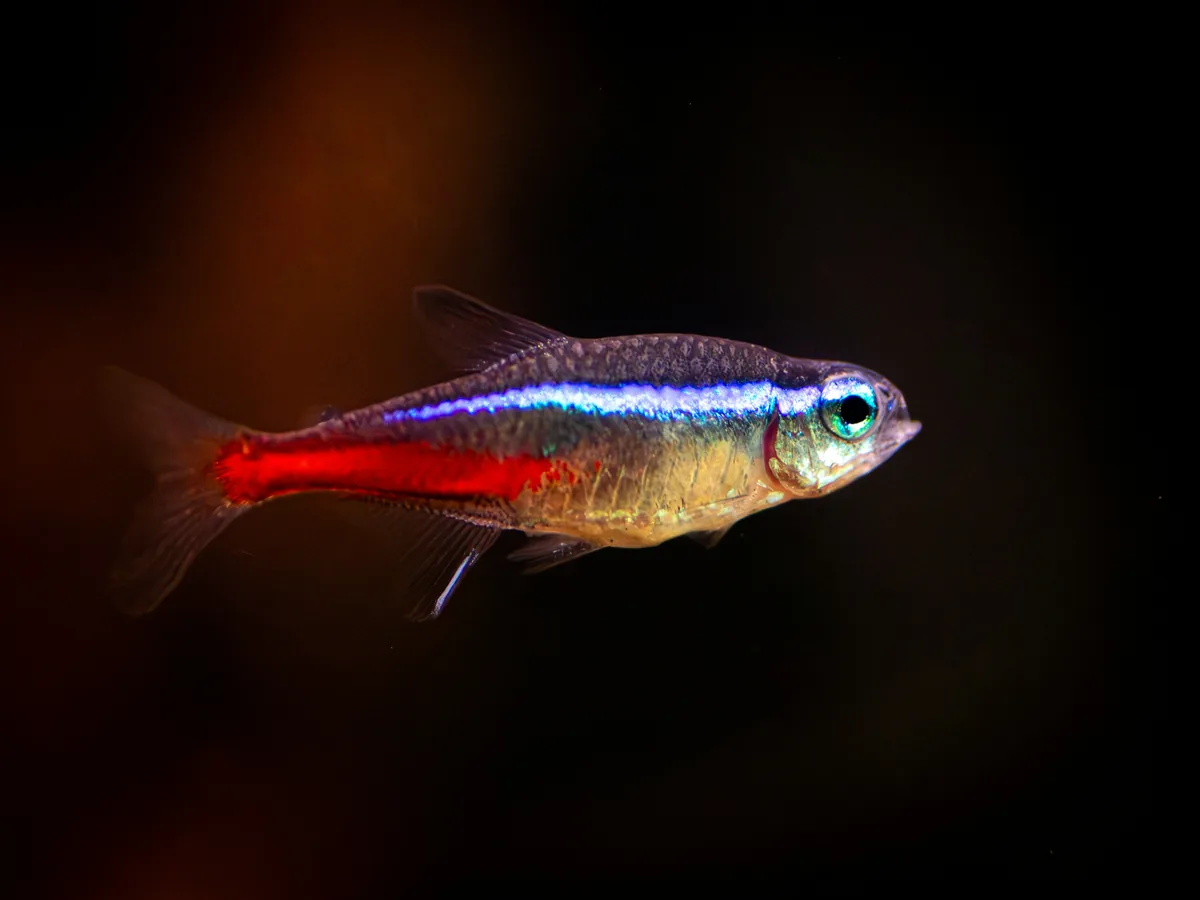
Quick Stats
| Adult Size | 3–4 cm |
| Minimum Tank | 10 gal |
| Temperature | 20–26°C |
| pH Range | 4.0–7.5 |
| Hardness (GH) | 1–10 dGH |
| Difficulty | Easy |
| Temperament | Peaceful, schooling |
| Diet | Omnivore — flakes, micro pellets, frozen daphnia, brine shrimp |
| Schooling | 6+ required (10+ better for display) |
Tank Setup
The Neon Tetra (Paracheirodon innesi) is the classic nano tetra — the bright blue-and-red schooling fish you see in every aquarium shop in the world, and the gateway fish for more hobbyists than any other species. They come from the slow, tannin-stained blackwater tributaries of the Amazon basin in Brazil, Colombia, and Peru, and they have been in the hobby since 1936. A 10 gallon tank is the realistic minimum for a school of 6–8, but a 20 gallon long lets them school properly and shows off the electric blue stripe far better.
Maintain water parameters within: temperature 20–26°C, pH 4.0–7.5, hardness 1–10 dGH. That pH range is unusually wide — wild-caught Neons come from extremely soft, acidic water (pH 4.0–5.5, near-zero hardness), but farm-raised Neons are bred to tolerate a much broader range and do perfectly well in neutral tap water. The one thing they do not tolerate is hard alkaline water with high pH — push them into pH 8.0+ and GH 15+ and they fade, stop breeding, and shorten their lifespan.
Set up the tank with dark sand or fine gravel, driftwood, and dense planting — Java fern, Anubias, Vallisneria, and floating plants like Salvinia or frogbit. A few Indian almond leaves on the substrate release tannins and recreate the blackwater look they come from; the stained water also makes the blue stripe glow more intensely. A gentle sponge filter or hang-on-back is plenty; they don't like strong current and they don't produce much bioload. Avoid bare-bottom tanks — Neons go pale and skittish without substrate and cover.
Tank Mates
Neon Tetras are peaceful, short-finned, and completely non-aggressive. That combination makes them one of the safest tetras to mix with anything community-friendly, and they are the default mid-water schooling fish for nearly every community tank in the hobby. They occupy the mid-water column and ignore fish that don't compete with them for food.
Compatible tank mates include: other Neon Tetras (mandatory — they school), Ember Tetras, Celestial Pearl Danios, Chili Rasboras, Harlequin Rasboras, Pygmy Corydoras, Otocinclus, Betta fish (in a 10 gallon or larger), Cherry Shrimp, Amano Shrimp, and Nerite Snails. They also work as dither fish for a single Apistogramma, a pair of Ram Cichlids, or a pair of Kribensis in a 20 gallon or larger. Avoid anything with a mouth large enough to swallow a 4 cm fish — that rules out angelfish (which eat Neons in the wild), full-sized gouramis, and most barbs.
Schooling is non-negotiable. Six is the absolute minimum; ten to fifteen is what I aim for in any tank 20 gallons or larger — and a 20 gallon long with fifteen Neons is one of the most iconic displays in the hobby. A group smaller than six will hide, lose colour, and spend the day pressed against the back glass. In a proper school they become a moving blue-and-red river that crosses the tank as one organism — and that is the entire reason to keep this fish.
Diet & Feeding
Neons are omnivores. In the wild they eat tiny crustaceans, insect larvae, worms, and zooplankton among the vegetation. In the aquarium they accept flakes, micro pellets, frozen daphnia, frozen brine shrimp, and the occasional live baby brine shrimp. They are unfussy feeders — unlike some nano fish, they will accept anything that fits in their mouths and they will compete aggressively at the surface.
Feed small amounts twice daily. I use a quality tropical flake (Omega One Tropical Flakes or New Life Spectrum) as the staple, with twice-weekly frozen daphnia or brine shrimp to keep the colour deep. A flake-only diet works for survival but the red and blue fades noticeably over months — Neons on a varied diet hold their electric colour for years; Neons on flake-only turn muddy and pale within six months.
They are surface and mid-water feeders, so floating or slow-sinking foods work best. They will not compete with bottom feeders for sunken pellets — feed Pygmy Corydoras separately with sinking wafers after lights-out if you keep them together. Neons will pick at biofilm and soft algae but they will not control an algae bloom. In a planted tank, a school of Neons and a small cleanup crew (Pygmy Corydoras + Cherry Shrimp) is a perfectly balanced combination.
Common Health Issues
Neon Tetras are hardy once established — they have been bred in captivity for nearly a century and the farm-raised fish are unfussy. The single disease you must know about is Neon Tetra Disease (Plistophora hyphessobryconis), a microsporidian parasite that infects the muscle tissue and is invariably fatal. There is no cure. The first sign is restlessness and loss of colour, followed by a characteristic curved spine as the muscle tissue is consumed. Once you see the curved spine, the fish is doomed and likely infectious to others.
Neon Tetra Disease is spread by cannibalism — healthy Neons eating the flesh of an infected dead or dying Neon. The only management is ruthless: at the first sign of restless, pale, or curved-spine fish, remove them to a hospital tank immediately and euthanise if the spine curvature is already present. Do not wait. Do not try to treat with antibiotics — they do not work against microsporidians. Bleach the hospital tank afterwards. The disease can wipe out a whole school in weeks if left to spread.
Beyond NTD, Neons are susceptible to ich when stressed, and the standard heat-and-salt treatment works fine. Raise temperature slowly to 28°C (1°C per day) and dose salt at 1 teaspoon per gallon. Copper-based medications work but dose at 75% of label rate; tetras are sensitive to copper. Prevention is straightforward: stable warm temperature, weekly 25% water changes with dechlorinated water, quarantine new fish for two weeks before adding them, and remove dead fish immediately. Neons typically live 5–8 years in good conditions — they are not short-lived fish when kept well.
Breeding
Neon Tetras are egg-scatterers and breedable in a home aquarium, though not as easily as some of the danios. Sexing is straightforward: females are rounder and slightly larger, especially when viewed from above; males are slimmer with a straighter blue stripe. Condition a group with live baby brine shrimp and frozen daphnia for a week, then move them to a 10 gallon spawning tank at 24°C, pH 5.0–6.0, hardness 1–4 dGH — soft acidic water is essential, hard water will not produce eggs.
Spawning happens in the early morning. A female scatters 50–150 adhesive eggs among the plants or spawning mop; the male follows and fertilises them. The eggs are light-sensitive — bright light will kill them — so dim the tank or cover it with a towel for the first 24 hours. Remove the adults immediately after spawning; they will eat every egg they can find within hours.
Eggs hatch in 24–36 hours. Feed the fry infusoria or commercially-prepared liquid fry food for the first three days, then graduate to vinegar eels or live baby brine shrimp. Neon fry are tiny — smaller than a grain of rice at hatch — and need microscopic first foods. They grow steadily and are free-swimming within a week, taking on the characteristic blue stripe at around six weeks and the full red colour at three months. This is a moderately challenging breeding project rather than an easy one, but the payoff is a tank full of home-bred Neons that are already acclimated to your water.
Frequently Asked Questions
What size tank do Neon Tetras need?
A minimum of 10 gallons for a school of 6–8. A 20 gallon long is better — the extra horizontal space lets the school display properly and the electric blue stripe shows far better against a longer dark background.
How many Neon Tetras should I keep together?
Six is the absolute minimum; ten to fifteen is what I aim for in any tank 20 gallons or larger. They are a true schooling fish and a group smaller than six will hide, lose colour, and spend the day pressed against the back glass. A proper school becomes a moving blue-and-red river across the tank.
What is Neon Tetra Disease?
Neon Tetra Disease (Plistophora hyphessobryconis) is a microsporidian parasite that infects the muscle tissue and is invariably fatal. The first sign is restlessness and loss of colour, followed by a characteristic curved spine as the muscle is consumed. There is no cure. The disease is spread by cannibalism — remove any infected fish immediately and do not let healthy fish eat dead ones.
Can Neon Tetras live with Betta fish?
Yes — Neon Tetras are a safe tetra choice for a betta tank in 10 gallons or larger. They are short-finned, peaceful, and not nippy. Keep them in a school of at least 6 so they focus on each other rather than the betta, and make sure the tank has broken sight lines so the betta has its own territory.