Quick Stats
| Adult Size | 4–6 cm |
| Minimum Tank | 10 gal |
| Temperature | 20–26°C |
| pH Range | 7.0–8.5 |
| Hardness (GH) | 8–20 dGH |
| Difficulty | Easy |
| Temperament | Peaceful, lively |
| Diet | Omnivore — flakes, micro pellets, frozen bloodworm, algae |
| Schooling | 1 male + 2–3 females (never 1M:1F) |
Tank Setup
The Platy (Xiphophorus maculatus) is the hardier cousin of the guppy — bigger (4–6 cm versus 3–5 cm for guppies), less heavily line-bred, and nearly indestructible in a properly set up tank. They come from the coastal streams and springs of southern Mexico, Belize, and Guatemala, where they live in weedy, mineral-rich water that's a long way from the soft, acidic streams most nano tetras come from. That origin matters: platies are livebearers, and livebearers want hard, alkaline water for proper osmoregulation and fry development. A 10 gallon is the floor for a breeding trio (1 male + 2–3 females); a 20 gallon long is where the species shows you what it does, because the extra horizontal space lets you keep a proper breeding ratio without anyone getting harassed to death and gives fry cover to grow out.
Water parameters: temperature 20–26°C, pH 7.0–8.5, hardness 8–20 dGH. That temperature range is the key difference from guppies — platies tolerate cooler water than guppies (which want 22°C minimum), with a floor of 20°C that means a platy tank in a typical heated house (20–22°C room temperature) can run unheated year-round. They breed fastest at 24–26°C and will live longer at cooler temperatures, but anything below 18°C suppresses immunity and should be avoided. The pH and hardness preferences are identical to guppies — hard, alkaline water, the opposite of what most nano tetras want. Captive-bred platies will live and breed at pH 7.4 and GH 12 without complaint, and they'll tolerate pH 7.0 / GH 8 if you're careful. What they will not thrive in is soft, acidic water (pH below 6.8, GH below 6). Aim for 24°C, pH 7.6, GH 12 — straight tap water in most regions, no RO, no active substrate. A small amount of aquarium salt (1 teaspoon per 5 gallons) is optional but beneficial.
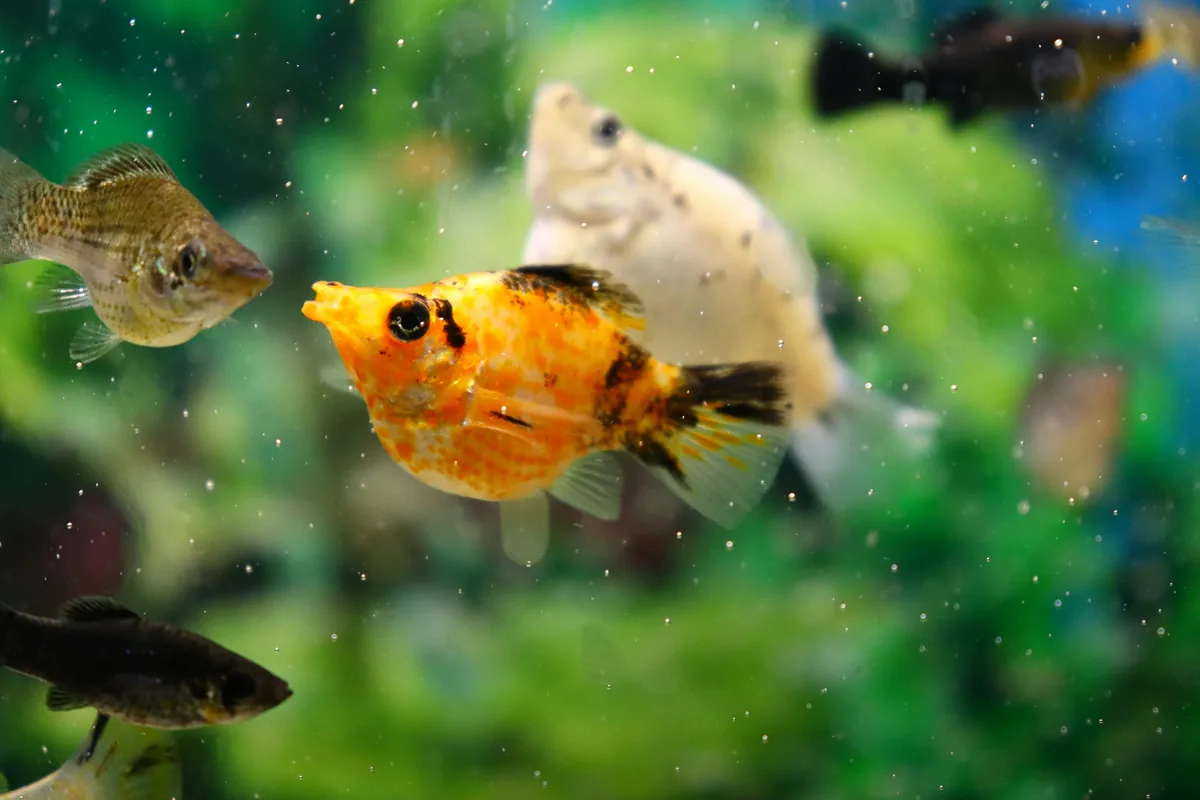
Set up the tank with a dark sandy or fine gravel substrate (platies don't dig like corydoras or kuhlis, so gravel is fine if you prefer it), driftwood, and dense planting along the back and sides. Floating plants (Salvinia, frogbit, water sprite) are non-negotiable if you want fry survival — platy fry are 7–8 mm at birth and will be eaten by their parents and each other if they have nowhere to hide. Java moss, guppy grass (Najas guadalupensis), and water sprite are the three plants I would not run a platy tank without; they provide cover for fry, surfaces for biofilm, and break up the swimming lanes so harassed females can escape males. Filtration should be gentle — a sponge filter is ideal because no intake can suck up fry, and a hang-on-back needs a sponge pre-filter on the intake. Platies are strong swimmers (stronger than long-finned fancy guppies) and tolerate moderate flow well. Lighting is flexible — brighter light brings out the orange and red colour forms; the fish don't care either way. The classic platy colour forms include: red wag (black body with red tail), coral (solid orange-pink), sunset (orange body with black tail and dorsal), tuxedo (black lower body, coloured upper body), and the ever-popular mickey mouse (a yellow-orange body with two black dots on the tail that look like Mickey Mouse ears — yes, really, that's the actual name of the strain).
Tank Mates
Platies are peaceful, lively, and too small to bother anyone. Males spend their day displaying to females and to each other — flashing their colours, dancing side-to-side, occasionally sparring without contact — and ignore other species almost completely. Females school among themselves and ignore everyone. The species is one of the safest nano fish in the hobby for a community tank, with two caveats: do not keep them with swordtails (see the Diet & Feeding section for the crossbreeding warning), and do not keep them with fish large enough to eat a 4 cm platy or with aggressive fin-nippers that will shred the males' tails.
Compatible tank mates: every common hard-water nano community fish. Platies live happily with guppies, mollies, swordtails (the crossbreeding warning applies — see Diet & Feeding), tetras that tolerate hard water (Black Skirt, Bloodfin, Glowlight — not Cardinals or Rummynose, which want soft water), Corydoras of every species, kuhli loaches, dwarf gouramis, honey gouramis, pearl gouramis, Otocinclus, Bristlenose Plecos, and dwarf cichlids (rams, kribensis — not Apistogramma in hard water). They are excellent dither fish for a shrimp tank — their mouths are too small for adult Cherry Shrimp, and a colony in a planted tank will out-produce any shrimplet losses. Snails (Nerite, Mystery, Malaysian Trumpet) are completely ignored. A single Betta can work in a 15 gallon with platies if the betta is mellow, but the platy's bright colours can sometimes trigger betta aggression — skip the betta if you are not sure. Platies are also one of the few community fish that thrive in an unheated tank alongside White Cloud Mountain Minnows and zebra danios, which makes them a useful species for a low-tech room-temperature tank.
Avoid: swordtails (the crossbreeding warning — see the Diet & Feeding section), any fish large enough to eat a 4 cm platy (angelfish, larger gouramis, rainbowfish larger than Melanotaenia praecox, goldfish, all cichlids except dwarf rams and kribensis), and aggressive fin-nippers (tiger barbs, serpae tetras, silver dollars, red-eye tetras — they will shred the males' tails). The single biggest mistake new platy keepers make is housing them with swordtails in a "livebearer community tank". Within three months the platy colony is no longer pure platies — not eaten, but absorbed into a hybrid swarm via crossbreeding with swordtails (same genus Xiphophorus). The second biggest mistake is keeping a single male with a single female — see the Breeding section for the 1:2-3 ratio rule that prevents the male from harassing the female to death. If you want just two platies, keep two males — they'll display to each other harmlessly and you get colour without the harassment problem. Platies are also one of the most jump-prone livebearers; a tight-fitting lid is mandatory.
Diet & Feeding
Platies are omnivores with a strong herbivorous lean — more so than most nano fish, and a bit more so than guppies. In the wild they eat algae, biofilm, detritus, insect larvae, and micro-crustaceans from the weedy springs and streams they live in. In the aquarium they accept every common food: flakes (high-quality tropical flakes with spirulina, not the cheap stuff), micro pellets (Hikari Micro Pellets, New Life Spectrum Thera+A 0.5 mm, Fluval Bug Bites), frozen daphnia, frozen brine shrimp, frozen bloodworm, live baby brine shrimp, and algae wafers. They will graze on algae and biofilm in a mature tank — one of the underrated benefits of the species is that they help with algae control without eating your plants.
Feed small amounts twice a day. Platies are surface-midwater feeders by habit and will chase food to the bottom, but they cannot compete with dedicated bottom feeders like corydoras — anything that hits the sand and stays there will be lost. A pinch of flake at the surface, a small pinch of micro pellet mid-water, and a small portion of frozen daphnia or BBS twice a week is the routine that gets you the best colour. The herbivorous lean matters: a pure-protein diet (frozen bloodworm only) will eventually cause digestive issues; mix in spirulina flake, algae wafers, or blanched spinach once a week. Colour responds fast to diet — a week of spirulina and BBS deepens the red and orange in sunset, coral, and red wag strains noticeably.
The crossbreeding warning is the most important thing to know about platies and swordtails. The two species — Xiphophorus maculatus (platy) and Xiphophorus hellerii (swordtail) — are in the same genus and will hybridise freely if kept together. The offspring are live, fertile, and produce viable F2 and F3 generations. The hybrids are usually intermediate in size and shape — some males develop a partial sword (longer than a pure platy, shorter than a pure swordtail), some don't — and neither parent strain is preserved. The same-sex-ratio rule that applies to platies and guppies also applies to swordtails: keep 1 male to 2–3 females. If you want pure platies, never house them with swordtails; if you want both species in one tank, accept that the fry will be hybrids within a few generations and don't try to sell the offspring as either pure species. The fancy platy strains (red wag, coral, sunset, tuxedo, mickey mouse, and dozens more) are the result of decades of line-breeding for colour — and unlike fancy guppies, platy strains are generally not as heavily line-bred, which is part of why platies are hardier and less prone to inbreeding issues. A bonus quirk: many commercial platies already have some swordtail blood from historical hybridisation, which is why some "platies" occasionally throw fry with a small sword extension on the male's tail. If you want pure platies, buy from a local breeder who can document the lineage.
Common Health Issues
Platies are hardy — genuinely hardy, in the same league as Bronze Corys and White Cloud Mountain Minnows, and noticeably hardier than fancy guppies. The main health issues I see are ich (almost always from temperature swings during shipping), fin rot (usually from poor water quality or a fin-nipping tank mate), and "livebearer shimmy" (a stress-induced condition where the fish rocks back and forth in place, caused by soft acidic water — the cure is to raise the GH and pH). They are not disease-prone and a properly maintained tank will keep a colony healthy for 3–4 years — platies are longer-lived than guppies (1.5–3 years) and offset their slower breeding rate with their longer lifespan.
Ich is treated with the standard heat-and-salt or formalin/malachite protocol. Platies are fully scaled, tolerate salt well (1 tablespoon per 5 gallons for 14 days is the textbook treatment, raising temperature to 28°C — do not exceed 30°C), and tolerate formalin-based medications (Rid-Ich, Kordon Rid-Ich Plus) at the label dose. The salt treatment is particularly appropriate for platies because they like the mineral content anyway. Copper-based treatments are not toxic to platies but should still be avoided in a community tank — if you have shrimp or snails, copper kills them. Fin rot responds to clean water (daily 30% water changes for a week) plus a broad-spectrum antibiotic (Maracyn, Kanaplex) in a hospital tank. The underlying cause is almost always poor water quality — fix the water and the fin regrows in 2–3 weeks. The "guppy disease" (Tetrahymena) protozoan that hits fancy guppies hard is much rarer in platies — they have more genetic diversity and a stronger immune system as a result.
Prevention is straightforward: weekly 25–30% water changes with dechlorinated, temperature-matched water (a small amount of aquarium salt is optional but beneficial — 1 teaspoon per 5 gallons); no ammonia, no nitrite, nitrate below 30 ppm; stable temperature; and a mature, cycled tank. Platies are livebearers and produce a noticeable bioload for their size, especially a breeding colony — the 30 ppm nitrate ceiling is realistic, not aspirational. Lifespan in good conditions is 3–4 years — longer than guppies (1.5–3 years) and longer than swordtails (2–3 years), with the upper end coming from cooler tanks (20–22°C) and pristine water. If your platies are dying within the first 6 months, look at water quality and the GH/pH first — the species is robust in hard alkaline water but does poorly in soft acidic water, and "livebearer shimmy" is the symptom that tells you the parameters are wrong. The cooler-temperature tolerance of platies is one of their underrated strengths: a 20°C tank that would slowly stress a guppy is a platy's comfort zone, and the lower temperature slows their metabolism enough to extend lifespan by 6–12 months versus a 26°C tank.
Breeding
Platies are livebearers — the female gives birth to free-swimming fry rather than laying eggs. They are among the easiest aquatic animals to breed; in a 10 gallon with both sexes present and a healthy population of Java moss, fry will appear within 4–6 weeks without any intervention from you. The male courts the female by displaying alongside her, flashing his colours, and dancing side-to-side; if the female is receptive, the male transfers sperm via the gonopodium (a modified anal fin that functions as an intromittent organ). Females can store sperm from a single mating for 6+ months and produce 4–6 broods from that one mating — which is why a "female-only" tank will still produce fry for months after the male is removed, and which is why two females from a mixed-sex tank will continue dropping fry long after you've rehomed every male.
The 1:2-3 sex ratio rule is the single most important thing to know about keeping platies — same rule as guppies and swordtails. A single male platy will harass a single female relentlessly — chasing her, nipping, never letting her rest — and she will weaken, stop eating, and die within weeks. The fix is one male to two or three females (or more females per male), so the male's attention is distributed and no individual female gets run to exhaustion. In a 10 gallon with 1 male + 3 females, the male still harasses — that's just what male livebearers do — but each female only gets a third of his attention and can recover between pursuits. The breeding explosion is the predictable consequence: two females in a tank with a male can become 40+ fry within a month, and the colony doubles every 4–6 weeks after that. Plan for this in advance — either have a plan for the fry (local fish store trade credit, give them away, use as feeders) or keep only males if you don't want a population explosion.
Gestation is 24–30 days at 24°C. A typical brood is 20–40 fry, slightly smaller than a guppy brood (30–50) because platies are slightly smaller-bodies than female guppies overall. The fry are 7–8 mm at birth, free-swimming immediately, and self-sufficient from day one — they will graze on infusoria and biofilm in a mature tank, or take powdered flake and live baby brine shrimp from day one. There is no parental care; the parents will eat the fry given the chance. Dense planting (Java moss, guppy grass, water sprite, floating plants) is the single biggest determinant of fry survival in a community tank — without cover, fry survival is 0–5%; with a thick moss carpet and floating cover, fry survival is 30–60%. Sexing is straightforward at 4–6 weeks: males develop the gonopodium (the modified anal fin) and stay smaller; females stay larger and develop the gravid spot (a dark triangular patch on the rear of the abdomen where the developing fry are visible through the body wall). The fancy colour forms (red wag, coral, sunset, tuxedo, mickey mouse, and more) do not always breed true unless you keep the strains in separate tanks — if you mix a red wag male with a sunset female, the fry are intermediate and neither strain is preserved. Casual keepers should accept that a mixed-tank colony will produce a wider range of colour patterns, and not try to sell the offspring as "pure" any strain in particular. And remember: if you keep platies with swordtails, you will have hybrid fry within weeks — the two species are too closely related to be kept together if you want pure strains of either.
Frequently Asked Questions
Can platies live in an unheated tank?
Yes — platies tolerate cooler water than guppies, with a minimum temperature of 20°C. In a typical heated house (20–22°C room temperature), an unheated 10 gallon platy tank is fine year-round. They breed fastest at 24–26°C and will live longer at cooler temperatures, but anything below 18°C suppresses immunity and should be avoided. If your house drops below 18°C in winter, a 25-watt heater is cheap insurance.
Will platies breed with swordtails?
Yes — platies (Xiphophorus maculatus) and swordtails (Xiphophorus hellerii) are in the same genus and will hybridise freely if kept together. The offspring are live, fertile, and produce viable F2 and F3 generations. The hybrids are usually intermediate in size and shape — some with a partial sword, some without — and neither parent strain is preserved. If you want pure platies, keep them in a separate tank from swordtails; if you want both species in one tank, accept that the fry will be hybrids within a few generations.
How many platies should I keep in a 10 gallon?
A 10 gallon comfortably holds 1 male and 2–3 females (a breeding ratio), or a single-sex group of 4–5 males if you don't want fry. Never keep 1 male with 1 female — the male will harass her to death, the same rule as guppies. Females are larger and plainer than males but still show good colour in most strains; if you want a colourful tank without fry, all-male works; if you want a self-sustaining colony, 1M:3F is the choice.
Are platies hardier than guppies?
Yes — platies are generally hardier than guppies, for two reasons. First, they tolerate a wider temperature range (down to 20°C, while guppies want 22°C minimum), which makes them more forgiving of heater failures and temperature swings. Second, they are less prone to inbreeding issues than fancy guppies — most platy strains are not as heavily line-bred as fancy guppy strains, so they retain more genetic diversity and vigour. They are also less prone to spinal curvature and 'guppy disease' (Tetrahymena), two issues that hit fancy guppies hard.