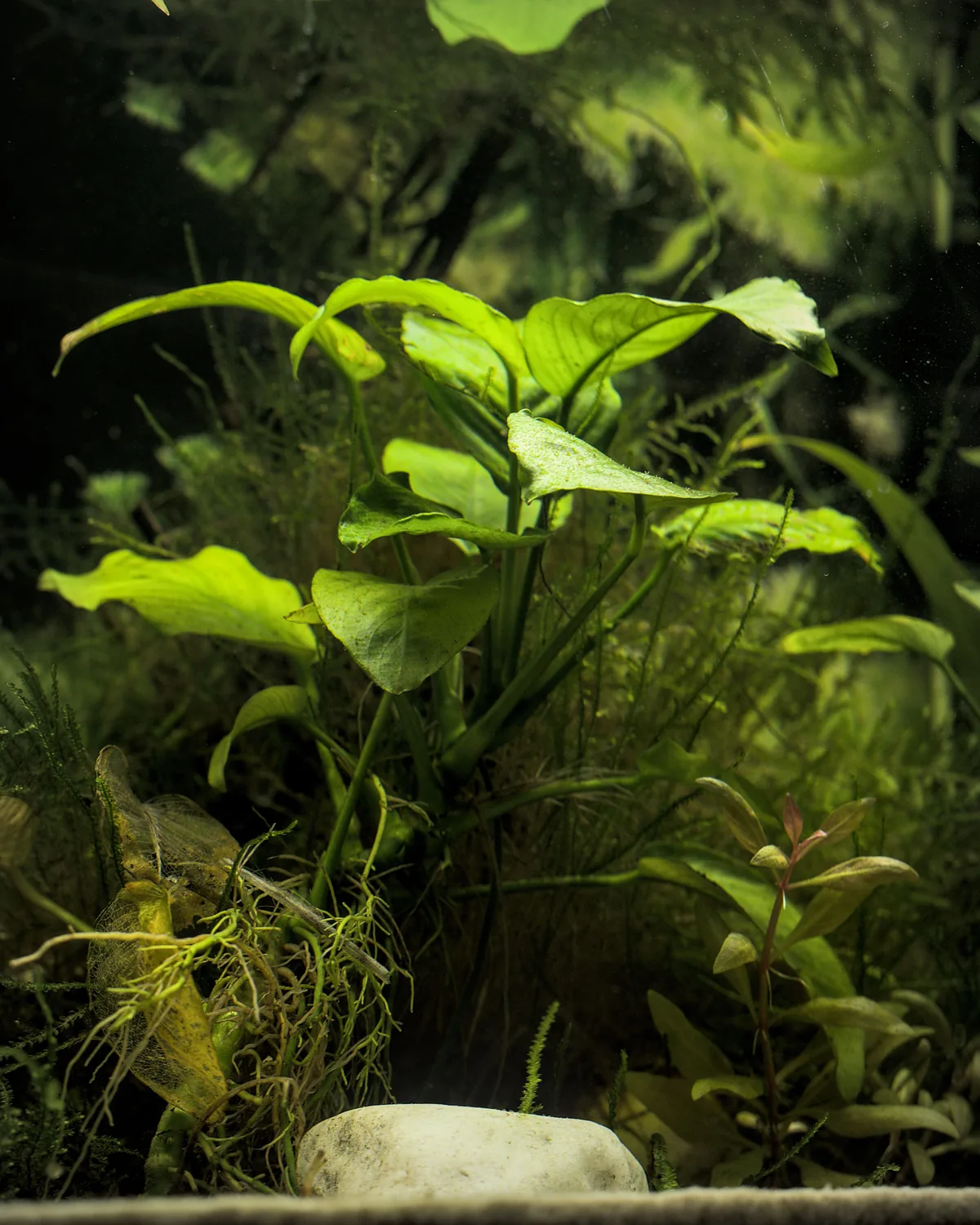
If Java fern is the plant I recommend to a complete beginner, Anubias is the plant I recommend to a beginner who keeps fish that destroy every other plant. Goldfish, African cichlids, silver dollars, plant-nibbling plecos — Anubias takes all of them and shrugs. Its leaves are thick, waxy, and apparently taste bad to almost every fish in the hobby. I have Anubias in a tank with a juvenile common pleco that shreds every Java fern leaf it can reach, and the Anubias is untouched. That is the Anubias pitch in one sentence.
The trade-off is speed. Anubias is the slowest-growing plant most aquarists will ever keep. A new leaf every 3 to 6 weeks is normal. A year of growth produces maybe 6 to 8 new leaves on a healthy plant. For a low-tech tank where you want stability rather than constant trimming, this is a feature. For anyone who wants to see growth — for the plant to "do something" — Anubias will feel glacial. Set your expectations now: this is a plant you put in a tank and then mostly leave alone for years.
Do not bury the rhizome. Like Java fern and bucephalandra, Anubias is an epiphyte. The thick green horizontal stem the leaves grow from must stay exposed to water flow. Bury it and it rots. Tie or glue the plant to driftwood or rock and let the roots anchor naturally over a few weeks. This is the single most common way beginners kill Anubias — second only to buying it potted in rockwool and assuming that means it should stay potted.
Quick Stats
| Parameter | Detail |
|---|---|
| Scientific name | Anubias barteri (and varieties) |
| Light requirement | Low to medium (15–40 PAR) |
| Growth rate | Very slow (new leaf every 3–6 weeks) |
| Difficulty | Very easy |
| Placement | Foreground to midground, attached to hardscape |
| CO₂ needed? | No — grows perfectly without |
| Temperature | 22–28°C (72–82°F) |
| pH range | 6.0–7.5 (5.5–8.0 tolerated) |
| Propagation | Rhizome division |
Tank Setup
Anubias is famously a low-light plant, and "low light" here means it. It will grow under the kind of dim stock LED that comes free with a 10 gallon kit. It will grow in a tank lit by a desk lamp. It will grow in a north-facing window (do not actually do this — sunlight causes algae, but the point stands: Anubias does not need much light). In fact, too much light is more dangerous than too little — under high light the slow-growing leaves become a magnet for green spot algae and brush algae, and the plant spends more energy fighting algae than growing.
Substrate does not matter to Anubias because the plant is not in the substrate. Attach it to a piece of driftwood, a rock, or even a porous ceramic decoration, and the roots will grip the surface within weeks. The plant pulls nutrients from the water column through its leaves and roots — neither needs substrate contact. This makes Anubias ideal for bare-bottom breeding tanks, quarantine tanks, and any setup where substrate is impractical.
Water parameters are forgiving. Anubias tolerates pH from 6.0 to 7.5, GH from soft to moderately hard, and temperatures from 22 to 28°C. It will survive brief excursions outside these ranges but chronic extremes cause decline. The one parameter Anubias genuinely dislikes is warm water above 30°C — it survives but stops growing and becomes algae-prone. If you have a discus tank running at 29°C, Anubias will live but will not thrive; consider Java fern instead.
Planting & Propagation
Like Java fern, Anubias is planted by attaching it to hardscape, not burying it. The two methods are the same: gel superglue (cyanoacrylate gel) on the rhizome, pressed to the wood or rock for 20 seconds; or tying with cotton thread. For Anubias, I strongly prefer the gel glue method because the rhizome is thicker and firmer than Java fern's, which makes it easier to glue without crushing the plant. Tie-able but fiddly.
If you buy Anubias potted in rockwool (the standard way it ships from nurseries), the first step is to remove the pot and gently tease the rockwool away from the roots. Do this under running water or in a bowl of tank water. You do not need to remove every fibre of rockwool — just the bulk of it — but try to expose the rhizome and the root structure. Once cleaned, attach the plant to hardscape with the rhizome exposed and the roots dangling. Within a few weeks the roots will grip the surface and the plant will be permanently attached.
Propagation is by rhizome division, full stop. Anubias does not produce leaf plantlets the way Java fern does. To propagate, wait until the rhizome is at least 4 to 5 inches long with several leaf clusters, then cut it cleanly between clusters with sharp scissors. Each piece continues growing as a separate plant. The cut surfaces heal within days and new growth appears within a few weeks. Do not cut the rhizome too small — each piece should have at least 3 to 4 leaves, or it will struggle to recover. A healthy mature Anubias can be divided into 3 to 5 new plants every couple of years.
The most common Anubias varieties in the hobby are A. barteri (large, ~30 cm leaves), A. barteri var. nana (small, ~5–10 cm leaves — the one most beginners want), A. nana ‘Petite’ (tiny, ~2–3 cm leaves — perfect for nano tanks), and A. coffeefolia (crinkled leaves with a unique puckered texture). For a 10 gallon, buy nana or nana Petite. For a 55 gallon, barteri works. Coffeefolia is the showpiece variety.
Compatibility
Anubias is the gold standard for plant-destroyer tanks. Goldfish, which shred most plants within days, ignore Anubias — the waxy leaves are unpalatable. African cichlids from the rift lakes, which dig up and eat plants as part of their natural behaviour, leave Anubias alone because it is attached to hardscape they cannot dig up and the leaves do not appeal to them. Silver dollars, the plant-eating terrors of the South American community tank, usually leave Anubias alone. Even Mbuna cichlids, which will eat most plants to the root, generally ignore Anubias.
For community tanks, Anubias is excellent. Tetras, rasboras, guppies, and livebearers do not touch it. Shrimp love it — the leaves accumulate biofilm that shrimp graze constantly, and the broad leaves give shrimp a surface to rest on. Betta tanks are a natural fit: Anubias nana Petite in a 5 gallon betta tank is one of the most photogenic combinations in the hobby. Breeding tanks benefit from Anubias because the broad leaves give egg-scattering fish a place to spawn and give fry cover from adults.
The fish that damage Anubias are the ones that physically crush it. Large plecos (common plecos, royal plecos, sailfin plecos) will rasp on Anubias leaves at night, leaving scrape marks and sometimes puncturing the leaves. Big cichlids (oscars, flowerhorns, parrots) may uproot Anubias if it is only loosely attached. None of these typically kill an established Anubias, but the leaves will show damage. Net out any floating fragments before they hit the filter.
Common Problems
Algae on the leaves: This is the #1 Anubias complaint and it is structural, not a sign of poor care. Anubias grows so slowly that each leaf sits in the tank for a year or more, giving algae time to colonise. Green spot algae (small dark green dots) and brush algae (dark fuzzy patches on leaf edges) are most common. The fix is not chemical — reduce light, increase water changes, and physically remove the worst-affected leaves. Amano shrimp and nerite snails help by grazing. Do not scrub the leaves; they bruise easily and damaged tissue grows more algae. The honest truth: a long-running Anubias tank always has some algae on older leaves. Accept it or trim them.
Rhizome rot: The #2 problem and it is almost always because the rhizome was buried. Lift the plant and inspect. A healthy rhizome is firm, dark green, and has roots from the underside. A rotting rhizome is soft, mushy, and smells bad. If only part of the rhizome is rotting, cut back to firm tissue and reattach above the substrate. If the whole rhizome is gone, salvage any leaves with attached rhizome fragments and try to root them separately.
Yellowing leaves: Usually a nutrient deficiency, most commonly nitrogen or potassium. Anubias is so slow-growing that deficiencies show up gradually — a leaf that took two months to grow will take weeks to yellow. The other cause is simply old leaves senescing: individual Anubias leaves live 1 to 2 years. If only the oldest leaves are yellowing and new growth is green, this is normal. Trim the yellow leaf at the base of the petiole.
Melting after purchase: Most Anubias sold in stores was grown emersed (out of water) at the nursery. The emersed leaves are thicker and stiffer than submerged-form leaves, and they often melt back when first submerged. This is normal. New submerged-form leaves will emerge from the rhizome within a few weeks. Do not pull the plant — the rhizome is alive and growing even when the old leaves look rough.
Holes in leaves: Typically potassium deficiency, especially if the holes appear surrounded by yellow tissue. Potassium is mobile in the plant, so deficiency shows on older leaves first. Dose a complete fertiliser containing potassium; recovery is slow but steady. Holes from physical damage (pleco rasping, fish nipping) look different — they are jagged and irregular rather than chlorotic.
Frequently Asked Questions
Why is my Anubias turning yellow?
Yellowing Anubias leaves are almost always a nutrient issue, most commonly nitrogen or potassium deficiency. Anubias is slow-growing, so deficiencies show up gradually — a leaf that took two months to grow will take two weeks to yellow. The other cause is the leaf simply being old: individual Anubias leaves live 1 to 2 years before being shed naturally. If only the oldest leaves are yellowing and new growth is green, this is normal senescence — trim the yellow leaf at the base of the petiole and move on. If new growth is also yellow, dose a complete liquid fertiliser including nitrogen and potassium.
Can Anubias grow out of water?
Yes, very well. Anubias is a semi-aquatic plant in nature and grows emersed (out of water) in nurseries because it grows faster and cheaper that way. In a paludarium, terrarium, or aquarium with the water level dropped, Anubias will happily grow emersed as long as the rhizome stays damp and humidity is high. The leaves grown in air are thicker, darker, and more rigid than submerged leaves. Most Anubias sold in stores was grown emersed, which is why it sometimes melts back when first submerged — the emersed leaves die off and are replaced by submerged-form leaves.
Why does algae grow on my Anubias leaves?
Because Anubias grows slowly, each leaf sits in the tank for a year or more, giving algae time to colonise it. Fast-growing plants constantly replace their leaves and stay cleaner. The fix is to reduce light, increase water changes, and physically remove the worst-affected leaves. Amano shrimp, nerite snails, and otocinclus all help by grazing on Anubias leaves. Avoid the temptation to scrub the leaves — they bruise easily and damaged tissue grows more algae. Do not move Anubias into deep shade; it will stop growing entirely and the algae will still win.
How fast does Anubias grow?
Slowly. A healthy Anubias barteri produces a new leaf every 3 to 6 weeks under low light, faster under medium light with fertiliser. The smaller Anubias nana grows even more slowly. A single plant may only put on 4 to 8 new leaves in a year. This is a feature, not a bug — Anubias is the plant you put in a tank you do not want to maintain. It will look essentially the same in a year as it does today, which is exactly what many aquarists want. If you want fast growth, Anubias is the wrong plant.
Recommended Products
Starter Kit Components
Best for: New aquarists building their first tank on a budget.
All the essentials without premium branding — tank, sponge filter, preset heater.
Mid-Range Setup
Best for: 10–20 gallon community tank with room to grow.
Aquaclear filter, adjustable heater, LED light, API test kit — the sweet spot.
Pro Breeder Setup
Best for: Serious hobbyists planning multiple tanks.
Canister filter, titanium heater, programmable light, liquid test kits — built to last.