Why Add Live Plants?
Live plants improve water quality by consuming ammonia, nitrite, and nitrate directly. They outcompete algae for nutrients, provide oxygen, offer cover and territory for fish, and make the aquarium look more natural. A well-planted tank is fundamentally a healthier tank.
All plants on this list grow well without injected CO₂, under standard aquarium lighting, and in a range of water conditions. They are genuinely beginner-proof.
1. Java Fern (Microsorum pteropus)
Java fern is arguably the most foolproof aquarium plant available. It thrives in low light, tolerates a wide range of parameters, and grows slowly enough that it never takes over. Crucially, it must be attached to rock or wood — not planted in substrate (burying the rhizome kills it). Tie to driftwood with thread or fishing line, or use superglue gel. Produces small plantlets on old leaves that detach and float away to establish themselves.
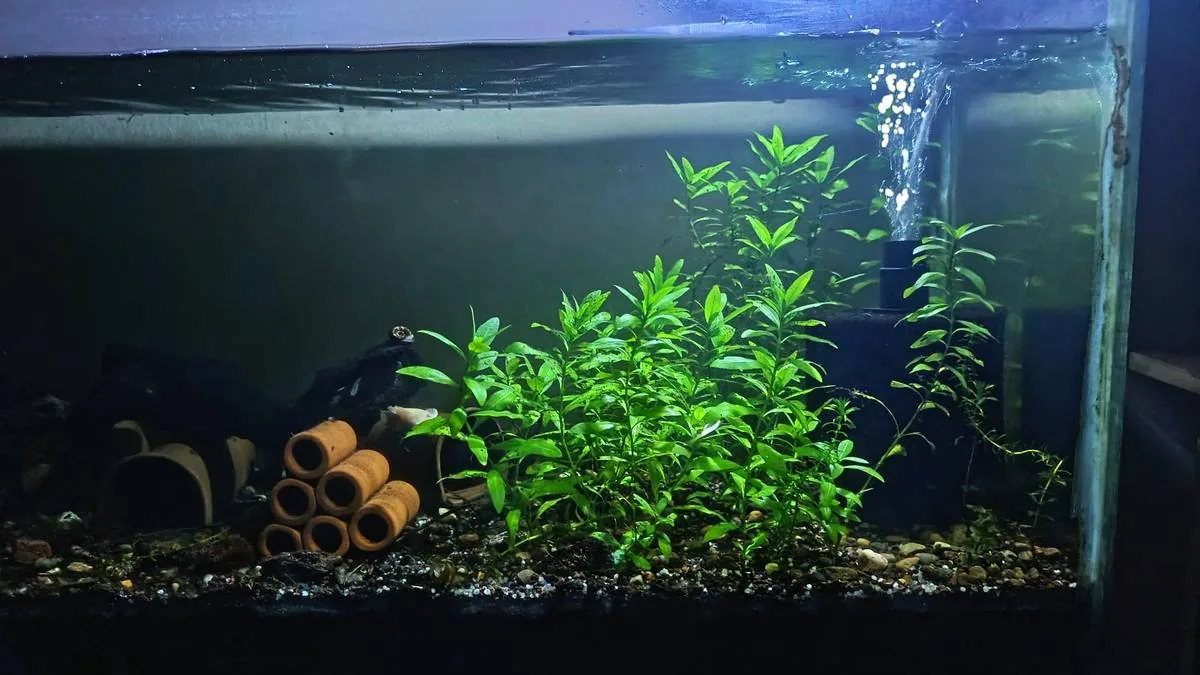
2. Anubias (Various species)
Anubias is the plant recommendation for tanks with plant-destroying fish. Its thick, waxy leaves are resistant to nibbling cichlids and goldfish. Like java fern, it must be attached to hardscape, not buried. It grows extremely slowly — which is a feature, not a bug, for beginners. Anubias barteri and A. nana are the most common species. Tolerates very low light and a wide pH range.
3. Java Moss (Taxiphyllum barbieri)
Java moss is a fine-textured moss that attaches to virtually any surface. It's used for aquascaping, breeding mops (fish and shrimp lay eggs in it), and softening tank décor. It needs no planting — simply wedge it under a rock or tie it loosely to driftwood. Grows faster in brighter light but survives almost anything. Ideal for shrimp tanks.
4. Vallisneria (Vallisneria spiralis / americana)
Vallisneria is a tall, grass-like plant that creates a natural background. It spreads rapidly by runners, filling in bare substrate over time. It tolerates hard alkaline water better than most aquarium plants — making it one of few good plant options for African cichlid tanks. Plant with roots buried but the crown (where leaves meet roots) at substrate level. Very fast-growing under good light.
5. Hornwort (Ceratophyllum demersum)
Hornwort is arguably the fastest-growing easy plant. It doesn't need to be planted at all — it can float freely or be loosely anchored. It consumes nutrients aggressively, making it excellent for controlling algae and nitrates in new tanks. The downside is shedding: hornwort drops needle-like leaves in response to stress, and these clog filters. Trim regularly and net out shed leaves. See our filter tips guide if hornwort is shedding into your filter.
6. Amazon Sword (Echinodorus bleheri)
Amazon swords are large, dramatic background plants. A healthy specimen can fill a 60-cm tank on its own. They grow from a rosette base and need their roots planted in a nutrient-rich substrate. Ideal for Walstad method setups where the organic soil layer provides root nutrition directly. Under bright light they grow quickly and produce impressive broad leaves.
7. Water Sprite (Ceratopteris thalictroides)
Water sprite is a delicate-looking but tough floating or planted plant with finely divided leaves. It provides excellent cover for surface-dwelling fish and fry. It grows rapidly under bright light and consumes nutrients quickly — a good algae competitor. Can be floated or planted, and reproduces by producing small plantlets on its leaves.
8. Cryptocorynes (Cryptocoryne spp.)
Cryptocorynes are excellent midground plants with broad, textured leaves. They come in dozens of species ranging from green to brown to deep red. They're slow to establish — often appearing to melt back when first planted (this is normal) — but once settled they're nearly indestructible. They're one of the few plants that genuinely prefer low to medium light. Avoid frequent replanting once established.
9. Duckweed (Lemna minor)
Duckweed is the most nutritionally efficient floating plant in the hobby. It multiplies exponentially under any light, consumes enormous amounts of nitrate, and provides shading that reduces algae on the substrate. The downside is it spreads uncontrollably — once in a tank it's nearly impossible to eradicate completely. Use it knowing it will take over the surface. Excellent for heavily stocked tanks where nitrate control is a priority.
10. Frogbit & Salvinia
Amazon frogbit and Salvinia species are more elegant floating plant options than duckweed. Frogbit has small, round lily-pad-like leaves with dangling root structures that fish hide in. Salvinia has distinctive velvety textured leaves. Both grow rapidly under bright light and consume nutrients effectively. Neither is as invasive as duckweed, though both will spread across the surface if not thinned regularly.
Planting Tips for Beginners
- Java fern and anubias must be attached to hardscape, not planted in substrate — burying the rhizome causes rot.
- Plant swords and crypts with roots buried but the crown at substrate level.
- New plants often melt slightly when introduced to a new tank. This is normal. Wait 3–4 weeks before concluding the plant has failed.
- Fertilise with root tabs beneath heavy root feeders (swords, crypts) and liquid fertiliser for floating and stem plants.
What actually grows for me — with no CO₂ and no fertiliser
The list above is the standard beginner shortlist, and it’s a good one. But after six years of low-tech, soil-based (Walstad-style) tanks, here are the four plants I actually reach for again and again — all grown with no pressurised CO₂, no dosing routine, and ordinary lighting.
- Hygrophila polysperma — my default “starter weed.” It grows fast, roots easily, and in a new tank it’s the single best tool for outcompeting algae because it drinks up the early nutrient surplus. I let it fill in, then trim and replant the tops. When a tank struggles with algae, more fast-growing hygrophila usually fixes it faster than any chemical.
- Bucephalandra — slow, but genuinely beautiful and nearly unkillable once settled. Like anubias, the rhizome must stay above the substrate; bury it and it rots. I glue or tie it to wood and rock and then mostly forget about it. Don’t panic at the “melt” when you first add it — it usually pushes new leaves within a few weeks.
- Anubias — the most forgiving plant I keep. Attach it to hardscape, give it low-to-moderate light (too much just grows algae on the older leaves) and leave it alone. Mine have survived tank moves, neglect and pleco grazing.
- Java fern — same rules as anubias: rhizome on top, attached to wood. It spreads slowly via plantlets on the leaf tips, which you can snap off and start elsewhere for free.
The pattern across all four is the same: epiphyte plants you attach to hardscape (anubias, bucephalandra, java fern) are almost impossible to kill and ask nothing of your substrate, while one fast stem plant (hygrophila) does the heavy lifting on water quality. That combination is what makes a low-tech tank stable without equipment.
If you’re setting up your first planted tank, plant it heavily from day one with cheap fast growers like hygrophila. An empty tank grows algae; a full one grows plants. I’d rather pull out excess hygrophila in a month than fight green water for one.