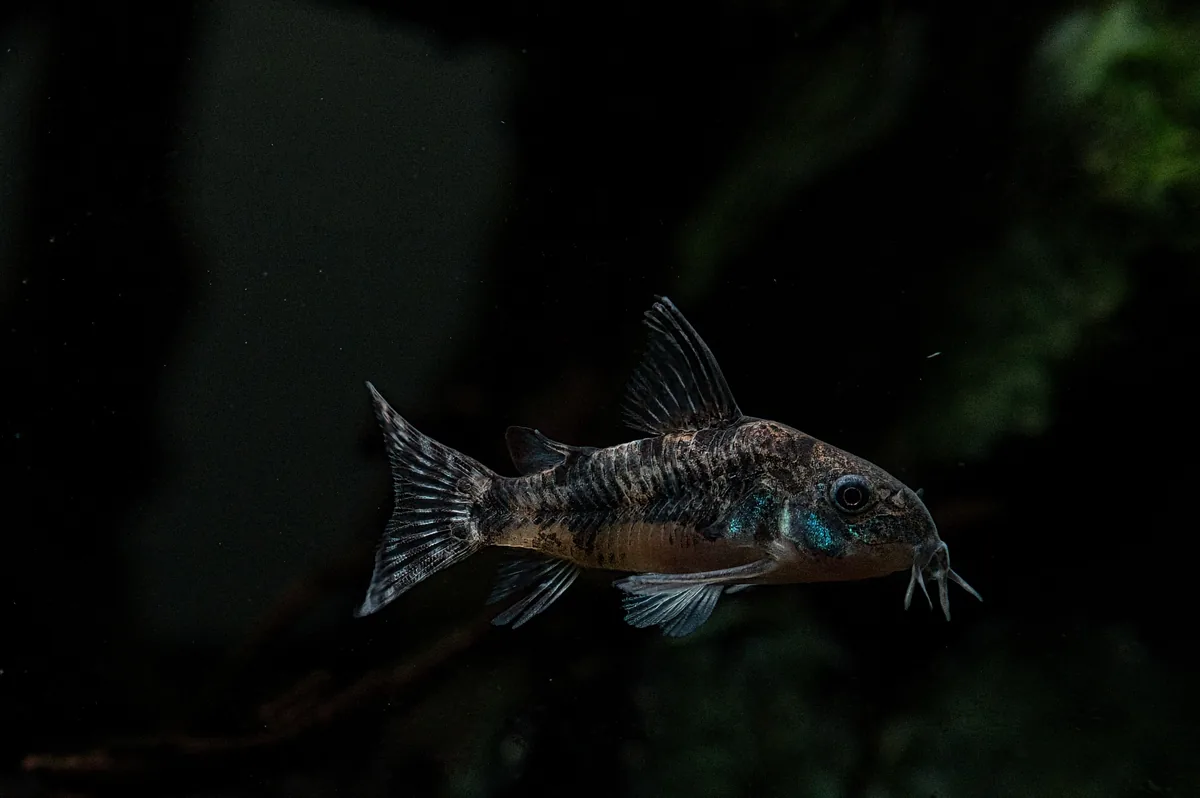
Corydoras are the first bottom dweller most aquarists keep, and they are usually the last bottom dweller they ever need. A school of six Panda corys working a sand substrate in a 20 gallon long is one of the most quietly satisfying things in the freshwater hobby — they are busy, they are social, they have actual personalities, and once you set the tank up correctly they are nearly bulletproof. This guide is the hub for every corydoras species we cover on Tank Logic. Read it once, then dive into the species pages linked throughout.
Sand substrate, or you will lose fish. Corydoras use their barbels to find food by sifting sand through their mouths and out through their gills. Sharp gravel abrades the barbels, the abraded tissue gets infected, and within weeks you have fish with eroded mouths and secondary bacterial infections. I have seen it kill entire groups. Sand is not a preference for corydoras — it is a structural requirement of how they feed. Skip the gravel aisle entirely.
Why Corydoras?
Corydoras fill a niche that almost no other nano fish does well: active, diurnal, social bottom dwellers that do not bother anyone and do not cost a fortune. Loaches hide all day. Plecos hide all day and grow enormous. Bristlenose stay small but they are still nocturnal. Corys are out in the open from morning to lights-out, sifting the sand in a coordinated group, and they are the only bottom dweller I would describe as fun to watch.
They are also genuinely easy fish. They tolerate a wide range of water parameters (with species-specific exceptions I will cover below), they accept every food you throw at them that sinks, they do not eat plants, and they do not bother tank mates. A beginner can keep Panda or Bronze corys successfully in their first tank. The catch is that "easy" is conditional on sand substrate, a school of six or more, and feeding them deliberately rather than assuming they will clean up after the other fish.
What surprises people most is the personality. Corydoras are not interchangeable little vacuum cleaners. A group of Sterbai will pile onto a single cube of frozen bloodworm like it is the last meal on earth. Pandas will perch on a leaf and just sit there, blinking, for no apparent reason. Pygmy corys school mid-water like tiny tetras. Skunk corys are shyer and need dither fish to feel safe. Once you have kept three or four species you start to see them as distinct characters, not "a corydoras".
The 8 Most Popular Corydoras Species
There are 170+ described species in the genus Corydoras, but the hobby runs on about ten. These eight plus Pygmy are what you will find in 95% of fish stores, and each has a dedicated care page on this site. Here is the snapshot, with the differences that actually matter when you are choosing:
| Species | Adult size | Temp range | Difficulty |
|---|---|---|---|
| Sterbai (C. sterbai) | 6–7 cm | 24–28°C | Easy |
| Panda (C. panda) | 4–5 cm | 20–24°C | Easy |
| Julii (C. julii) | 5–6 cm | 23–26°C | Medium |
| False Julii (C. trilineatus) | 5–6 cm | 23–26°C | Easy |
| Bronze (C. aeneus) | 6–7 cm | 22–26°C | Very easy |
| Peppered (C. paleatus) | 6–7 cm | 18–24°C | Very easy |
| Albino (usually C. aeneus) | 6–7 cm | 22–26°C | Very easy |
| Skunk (C. arcuatus) | 4–5 cm | 22–26°C | Medium |
| Pygmy (C. pygmaeus) | 2.5–3 cm | 22–26°C | Easy |
Sterbai corys are the warm-water corydoras. They tolerate 28°C indefinitely, which makes them the right cory for a discus tank, a German blue ram tank, or any tank that runs warmer than standard community temperatures. They have a dark body with white spots and bright orange pectoral fins in mature males. They are the cory I recommend most often to people who already have a tropical tank at 26°C+ and want a bottom dweller that will actually thrive rather than just survive.
Panda corys are the cute ones. Black mask over the eyes, black dorsal saddle, black tail blotch on a pale pink body. They stay small (4–5 cm), they are peaceful, and they are the most popular corydoras in the hobby by a wide margin. The catch: they want cooler water than most tropical tanks run, ideally 20–24°C. A Panda cory kept at 28°C will live a short, stressed life. Match the temperature to the fish.
Julii corys are the rare ones. True C. julii is from a small range in Brazil and exports are limited; almost everything sold as "Julii" in the trade is actually the False Julii (C. trilineatus). True Julii have a snake-head pattern of short disconnected squiggles on the head; False Julii have connected reticulated lines. If you want the real thing, buy from a specialist seller and expect to pay three times the price of a False Julii.
False Julii corys (C. trilineatus) are what 99% of "Julii cory" labels in stores actually point at. They have the same three-stripe body pattern and the same general look as the true Julii, but they are hardier, cheaper, and more widely bred. For everyone except corydoras collectors, the False Julii is the right fish to buy — and it is the fish you are getting whether you know it or not.
Bronze corys (C. aeneus) are the classic. They are the corydoras your grandfather kept. Bronze-green body, pink belly, bulletproof, breeds readily, tolerates almost anything. If you are not sure which cory to start with and your tank is 22–26°C, get Bronze. They are also the species most commonly available in albino, green, and gold colour morphs.
Peppered corys (C. paleatus) are the cold-water cory. They tolerate 18°C and are the only corydoras I would put in an unheated tank with White Cloud Mountain Minnows. They are mottled grey-green, slightly larger than Panda, and they spawn freely in cooler water. If your house sits at 20–22°C year-round, this is your cory.
Albino corys are not a species — they are a colour morph, almost always of C. aeneus (Bronze) or sometimes C. paleatus (Peppered). Pink body, red eyes, otherwise identical care. Albinos are slightly more sensitive to bright light than the normal colour forms; in a heavily lit planted tank they will spend more time hiding. They are the most commonly available cory in big-box pet stores.
Skunk corys (C. arcuatus) are the sensitive ones. Black stripe running from nose over the back to the tail — hence "skunk". They are beautiful but they are the cory I see beginners fail with most often. They want pristine water, stable parameters, and a school of at least six of their own kind. They are also notorious for the "skunk cory death" — sudden overnight die-offs with no obvious cause, probably stress-related. Not a beginner cory.
Pygmy corys (C. pygmaeus) are the mid-water cory. At 2.5–3 cm they are the smallest corydoras in the hobby, and unlike every other species on this list they school in the water column, not on the substrate. A group of 10 in a 10 gallon planted tank is one of the most underrated nano combinations available. They still need sand — they will sift — but they spend half their time swimming mid-water. The full guide is here.
Tank Setup
A 20 gallon long is the realistic minimum for a school of six standard-sized corydoras (Bronze, Peppered, Sterbai, Panda). The 30-inch footprint matters more than the gallon count — corydoras are bottom fish and they need lateral floor space to school, sift, and establish individual feeding territories. A 20 gallon tall gives the same water volume but a smaller footprint, and it is a worse tank for corys at every measurable level. Pygmy corys can go in a 10 gallon; everything else wants the 20 long minimum.
Sand substrate is non-negotiable. Pool filter sand, play sand (rinsed until the water runs clear), or CaribSea Super Naturals are the three options I have used long-term. Depth should be 3–5 cm — deep enough that the corys can plunge their whole head in to sift. Avoid sharp gravels entirely, and avoid even smooth gravels over 4 mm because corys cannot effectively sift them. Dark-coloured sand brings out the corydoras colour; light sand washes them out. Decorate with driftwood, smooth river rocks, and low plants like Anubias or Java fern — leave the front half of the tank open sand for foraging.
Flow should be gentle. Corydoras come from slow-moving tributaries and backwaters; a powerhead blasting them across the tank stresses them and stops them feeding. A sponge filter, a hang-on-back turned down, or a canister with a spray bar positioned along the back wall are all appropriate. Aim for turnover of 4–6 times tank volume per hour — enough to keep the water clean, not enough to push the corys around. If you see your corys huddled behind a rock out of the current, you have too much flow.
Water Parameters
Corydoras parameters vary by species more than most guides acknowledge. The safe baseline is pH 6.5–7.5, GH 5–15 dGH, KH 3–8 dKH, temperature 22–26°C. That covers Bronze, False Julii, Albino, and Skunk. Outside that baseline you need to pick the species carefully.
Panda and Peppered want the cool end — 18–24°C. Sterbai want the warm end — 24–28°C and will happily live at 29°C alongside discus. True Julii want soft, acidic water (pH 6.0–7.0, GH under 8). Pygmy corys are adaptable across pH 6.0–7.5 but want stable parameters; they melt down fast in swings. The single most important parameter for every corydoras is ammonia — corys are the first fish to die when a filter slips, because they are right down where the ammonia concentrates at the substrate.
Test your tap water for pH, GH, and KH before you choose a species. If your tap is liquid rock (pH 8, GH 20+), stick with Bronze, Peppered, or Albino — they are tank-bred for generations and tolerate harder water than wild corydoras ever would. If your tap is soft and acidic, Panda, Julii, and Sterbai are all on the table. The species that gives you the least trouble is the one that already matches your water.
The Sand Substrate Rule
This deserves its own section because it is the number one corydoras mistake and it kills more fish than every other cause combined. Corydoras barbels — the whisker-like structures around their mouths — are sensory organs covered in taste buds. They use them to find food in the substrate. Sand lets them plunge their whole face in, sift the sand through their gills, and extract food particles. Gravel stops this behaviour entirely and abrades the barbels in the process.
The progression is predictable. First the barbels shorten. Then the skin around the mouth goes pink and inflamed. Then you see fish "yawning" constantly or rubbing their faces on rocks. Then one fish stops eating and starts hiding. Then it dies. Then a second fish follows the same path two weeks later. By the time you notice the pattern, you have lost half the school. Switching to sand at that point saves the survivors but does not reverse the damage already done.
The myth that gravel is fine comes from pet store displays, where corys sit on gravel for a few weeks before being sold. They survive the display because they are not there long enough for the damage to compound. In a home tank over six months, the same gravel kills them. Sand is cheaper than gravel, easier to clean (just vacuum the surface), and looks better with corys. There is no argument for gravel.
Schooling: Six Minimum, Same Species
Corydoras are schooling fish. A group of three is not a school, it is three stressed fish. Six is the minimum I recommend for any standard corydoras species; eight to ten is better; pygmy corys want ten or more because their security scales with group size. A solo corydoras is a fish that will hide all day, lose colour, and die within months of stress-related disease.
Same-species schooling matters. Different corydoras species will loosely associate in a tank, but they do not truly school together. Six Pandas school. Three Pandas plus three Bronzes is two groups of three stressed fish. If you want to keep multiple corydoras species in one tank — which is fine in a 40 gallon or larger — get six of each, not three and three. The visual effect of mixed-species groups is appealing, but the fish do not see it that way.
Sex ratio is not critical for corydoras unless you are trying to breed them, but a mix of males and females is healthier than an all-male group. In most species females are larger and rounder-bodied; males are smaller and slimmer. A ratio of two females to one male is ideal for breeding. Pet store corys are usually unsexed juveniles, and you will get whatever mix you get — in a group of six the odds of getting at least one of each sex are very high.
Diet
Corydoras are carnivores. They are not omnivores, they are not scavengers, and they absolutely do not eat algae. In the wild they sift sand for insect larvae, worms, crustaceans, and decaying organic matter. In the aquarium they need a protein-rich diet delivered to the bottom — they will not compete for food at the surface and they will not eat flakes that float.
The staple should be a quality sinking pellet — Hikari sinking wafers, Omega One shrimp pellets, or Repashy Community Plus gel food. Supplement two to three times a week with frozen bloodworm, frozen brine shrimp, or live blackworms. Corydoras go genuinely crazy for bloodworm — a cube dropped into a school of six will be gone in under a minute. Avoid the dried bloodworm blocks sold in jars; they are nutritionally poor compared to frozen. Feed once a day, an amount the group consumes in two to three minutes.
The mistake is assuming the corys will eat what the other fish miss. They will not. Tetras and guppies grab food at the surface and mid-water, flakes disintegrate before they reach the bottom, and the corys are left with nothing. You have to deliberately drop sinking food into the tank where the corys can find it. Watch them for the first 30 seconds after feeding — if they are not actively eating, you are underfeeding them.
The Surface Darting Behaviour
Corydoras periodically dart to the surface, grab a bubble of air, and dive back to the bottom. New keepers panic every time, convinced their fish are suffocating. They are not. Corydoras are facultative air-breathers: they have a modified, vascularised section of intestine that lets them absorb oxygen from swallowed air. This is a normal behaviour you will see every few minutes in a healthy group.
The behaviour evolved because corydoras come from seasonal waters that go hypoxic in the dry season — warm, stagnant, low in dissolved oxygen. The air-gulp is an adaptation that lets them survive in water no other fish could. In a well-oxygenated aquarium they do not need it, but they retain the behaviour because it is hard-wired. A corydoras that never darts to the surface is unusual; one that is constantly at the surface gasping is in trouble.
The line between normal and abnormal is frequency. A dart every few minutes per fish is normal. Multiple fish constantly at the surface, gasping, is a sign of low oxygen — check that your filter is running, your temperature is not above 28°C (warmer water holds less oxygen), and your bioload is not overwhelming the filter. Corydoras are your early warning system; they are more sensitive to oxygen depletion than most community fish.
Breeding: The T-Position
Corydoras breed readily in home aquariums. They are egg-scatterers — no parental care — and the spawning trigger is a cold water change. The procedure I have used to spawn Pandas, Bronzes, and Sterbai: feed heavily on frozen bloodworm for a week, then do a 50% water change with water 4–5°C cooler than the tank. The barometric and temperature drop simulates the start of the rainy season, which is when corys spawn in the wild. Spawning usually follows within 24 hours.
The spawning behaviour itself is unmistakable. The male chases the female around the tank. When she is ready, she forms a "T-position" with him — she turns 90 degrees to his body and presses her mouth against his genital opening. He releases sperm; she cups her pelvic fins together to catch a batch of eggs, fertilises them internally, and then swims off to stick them on the glass, a plant leaf, or your filter intake. The pair repeats this 20 to 50 times over an hour or two.
Eggs hatch in 3–5 days depending on temperature. The parents will eat the eggs and the fry, so either remove the eggs to a hatching container or remove the parents. Fry are tiny and need infusoria or liquid fry food for the first week, then newly hatched brine shrimp. They grow fast — a Bronze cory fry is a recognisable miniature adult by six weeks. This is one of the most rewarding breeding projects in the hobby, and the trigger is so reliable that you will probably end up with fry by accident.
Common Health Issues
The big three are barbel erosion, red blotch disease, and stress-related die-offs. Barbel erosion is gravel damage — covered above. The cure is sand and clean water; mild cases recover in a few weeks once the substrate is switched. Severe cases where the barbels are gone entirely usually do not recover; the fish either dies of secondary infection or lives out a shortened life unable to feed effectively.
Red blotch disease shows up as angry red patches on the belly, often with visible blood vessels. It is a bacterial infection, almost always triggered by poor water quality — high nitrates, detectable ammonia, or a dirty substrate. Treatment is large daily water changes (50%+), substrate vacuuming, and an antibiotic if it does not respond within a week. Catch it early and the fish survive; miss it for a few days and you lose the whole group. I have seen red blotch wipe out a school of Skunk corys in 48 hours.
The third pattern — the sudden overnight corydoras death — is almost always stress. New fish in a tank that has not been properly cycled, a temperature swing from a broken heater, a pH swing from an over-enthusiastic water change, or simply a fish that was already sick from the store. Corydoras are sensitive to parameter swings; the cure is stability. If you are losing corys and the parameters look fine, test again — the swing may have been overnight while you were asleep.
Corydoras Myths
Myth 1: Corydoras clean your tank. They do not. They clean the sand of leftover food, which is useful, but they do not clean the glass, they do not clean the filter, and they do not clean the water column. A tank with corydoras still needs the same maintenance as a tank without them. The "cleaner fish" framing comes from pet stores that want to sell you a fish to fix your maintenance problem; it does not survive contact with reality.
Myth 2: Corydoras eat algae. They do not. Corydoras are carnivores. They will pick at algae wafers if there is nothing else to eat, but they derive no nutrition from algae and the wafers will rot in the tank before the corys get anything from them. If you have an algae problem, the answer is Nerite snails, Amano shrimp, Otocinclus, or a Bristlenose pleco — not corydoras.
Myth 3: Corydoras will eat whatever the other fish miss. They will not. Tetras and guppies eat at the surface and mid-water; the food that sinks is what the corys get, and it is rarely enough. Corydoras that look skinny, hollow-bellied, or constantly foraging are hungry. Feed them deliberately with sinking food, two to three minutes of consumption per feeding, and watch them actually eat. A well-fed corydoras is plump through the belly; a hungry corydoras is flat or concave.
Frequently Asked Questions
Do Corydoras clean the tank and eat algae?
No. Corydoras are carnivores that sift the sand for leftover food, bloodworm, and insect larvae. They do not eat algae and they do not clean the glass or substrate of anything other than missed pellets. If you want algae control, get Nerite snails, Amano shrimp, or Otocinclus — and feed your corys separately.
Why are my corydoras darting to the surface?
This is normal. Corydoras are facultative air-breathers — they swallow air at the surface and absorb oxygen through a modified vascularised intestine. You will see them dart up, grab a bubble, and dive back down every few minutes. It is not a sign of low oxygen unless they are doing it constantly and the rest of the fish are also gasping at the surface.
Can I keep corydoras on gravel?
No. Sharp gravel damages the barbels corydoras use to find food, the damaged tissue gets infected, and you lose fish to barbel erosion and secondary bacterial infections. Sand is non-negotiable — pool filter sand, play sand, or CaribSea Super Naturals. Smooth rounded pea gravel under 3 mm is sometimes tolerated but is still not ideal.
How many corydoras should I keep together?
Six minimum, of the same species. Corydoras are schooling fish and a group of three or four is a stressed group. Different species will loosely associate but they do not truly school together — six Panda corys is correct, three Panda and three Bronze is not. Pygmy corys want 8 to 10 minimum because they are smaller and bolder in numbers.
How do I trigger corydoras to spawn?
A large, cold water change. Feed heavily on frozen bloodworm and brine shrimp for a week, then do a 50 percent water change with water 4 to 5 degrees Celsius cooler than the tank. The temperature drop simulates the start of the rainy season. Spawning usually follows within 24 hours, with the female laying sticky eggs on the glass, plants, or your filter intake.