What This Hub Is (and Isn't)
A filterless aquarium is not a shortcut and it is not an untreated puddle. It is a specific technique: a biologically mature, heavily planted, lightly stocked tank where plants, substrate, surfaces and their microbial communities do a meaningful share of the waste processing that a filter would otherwise own. Done properly it is quiet, natural-looking and genuinely satisfying. Done carelessly it is just a small, dirty bowl with fish in it, and the fish pay the price.
This hub ranks candidate fish for that technique — nothing else. It does not claim any fish can be kept in untreated water, that plants automatically eliminate all waste, or that removing the filter removes the maintenance. Every recommendation below assumes the rules in the next section are followed. If you are new to the hobby, cycle a filtered tank first, learn to read your water tests, and come back to the filterless question once you can keep a normal planted tank stable — the cycling guide and the beginner mistakes guide are the prerequisites, not optional reading.
The Rules a No-Filter Tank Lives By
These are not preferences or fine print — they are the conditions that make the technique defensible at all. Skip one and the tank is no longer "no filter", it is simply unfiltered.
- The tank must be biologically mature before fish go in. That means fully cycled (run the fishless cycle first), then preferably several more months of plant growth and microbial establishment. The nano tank cycling guide covers the small-tank version. A filterless tank added to on day one is a fish-in cycle with no safety net.
- Ammonia and nitrite must read zero, always. Test on a schedule, not on a hunch. Any reading above zero means stop feeding, water-change, and fix the cause. The ammonia guide explains why even small amounts matter.
- The whole system does the work. Fast-growing plants, a healthy substrate, microbial communities on every surface, a restrained feeding rate, low stocking density and regular water changes all matter together. Remove one pillar — overfeed for a week, let plant mass collapse, stock like a normal tank — and the system stops coping. The Walstad method guide and the low-tech planted tank guide cover the planted side in depth.
- Regular water testing and water changes remain necessary. Weekly-to-fortnightly partial changes, matched for temperature and dechlorinated, are how you remove accumulated dissolved waste that plants and substrate cannot fully handle. The water change guide still applies to you. The water parameters guide explains what your test kit is telling you.
- Aeration, circulation and heating may still be required. "No filter" does not mean "no equipment". A gentle air stone or small circulation pump keeps the surface exchanging gas; warm-water species still need a heater. The filter types guide explains what you are choosing to go without, and what a sponge filter adds if you change your mind.
- Tolerating low flow is not the same as suiting a filterless tank. The absence of a filter does not automatically make a tank suitable for every fish that dislikes current. Plenty of still-water species still need high-oxygen, high-cleanliness conditions that an unplanted filterless tank will never provide. Each entry below names the specific requirement that earns (or loses) its tier.
- Frequent water changes cannot compensate for every underlying problem. They buy you margin, not immunity. Overstocking, overfeeding, an immature system or the wrong species will fail no matter how much water you swap. Fix causes, not symptoms.
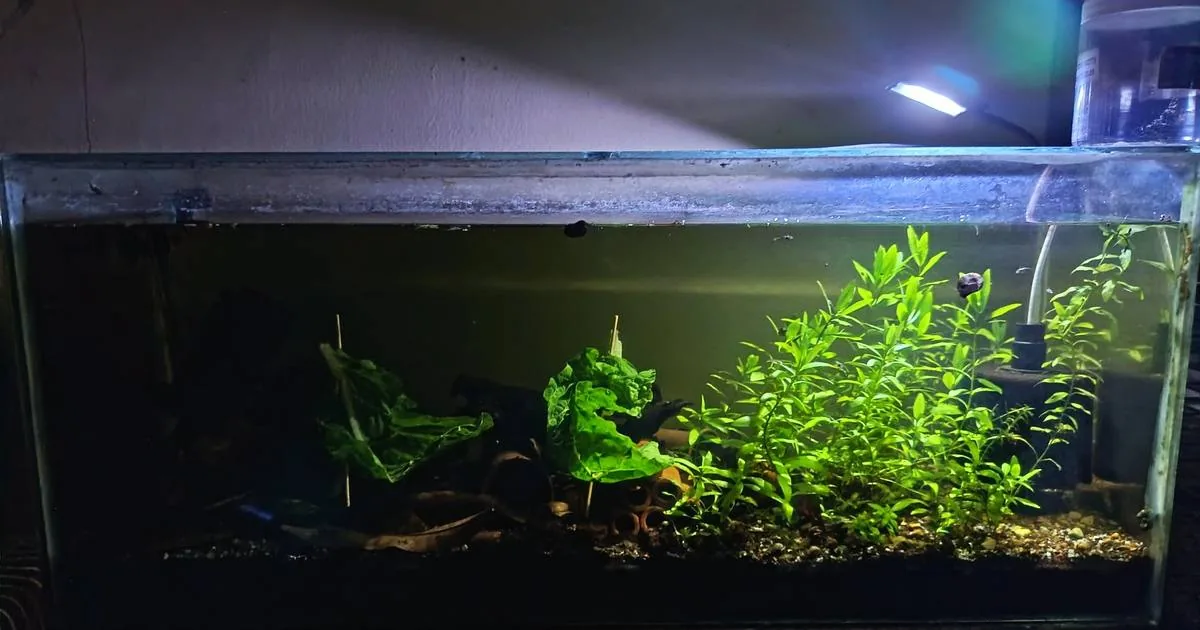
The engine of a filterless tank: dense, fast-growing plant mass and a mature substrate. Everything else in this guide is downstream of this picture.
How the Tiers Work
The three tiers are comparative guidelines, not guarantees of survival. An S-Tier fish in an immature, overstocked, overfed tank will die exactly as fast as any other fish, and a B-Tier fish in a superb, stable, well-managed system may thrive for years. Tier placement weighs four things: total bioload per fish, tolerance of still water and moderate oxygen levels, how forgiving the species is of imperfect water, and how easily its core requirements (temperature, group size, space) can be met without a filter's backup.
The tiers are deliberately unequal in size — the fish earn their placement individually, and I have not forced a fixed number into each tier. Ties within a tier are real, so the ranking inside each tier is a soft order, not a verdict. Two of the eighteen candidates ended up in B-Tier, and that is a feature of the evidence, not a quota.
Swimming zones below are approximate observations, not hard boundaries — most fish move through more than one layer, and pygmy corydoras in particular treat "zone" as a suggestion.
| Tier | # | Species | Main zone | Profile on Tank Logic |
|---|---|---|---|---|
| S-Tier strongest candidates | 1 | Japanese Rice Fish / Medaka (Oryzias latipes) | upper water | — |
| 2 | White Cloud Mountain Minnow (Tanichthys albonubes) | middle water | Full profile | |
| 3 | Endler's Livebearer (Poecilia wingei) | middle / upper | Full profile | |
| 4 | Least Killifish (Heterandria formosa) | middle / surface | — | |
| 5 | Betta (Betta splendens) | surface / upper | Full profile | |
| 6 | Chili Rasbora (Boraras brigittae) | middle water | Full profile | |
| A-Tier reasonable when requirements met | 1 | Honey Gourami (Trichogaster chuna) | upper / middle | — |
| 2 | Sparkling Gourami (Trichopsis pumila) | middle / lower | — | |
| 3 | Ember Tetra (Hyphessobrycon amandae) | middle water | Full profile | |
| 4 | Guppy (Poecilia reticulata) | middle / upper | Full profile | |
| 5 | Harlequin Rasbora (Trigonostigma heteromorpha) | middle water | Full profile | |
| 6 | Pygmy Corydoras (Corydoras pygmaeus) | variable | Full profile | |
| 7 | Clown Killifish (Epiplatys annulatus) | surface | — | |
| 8 | Phoenix Rasbora (Boraras merah) | middle water | — | |
| 9 | Dwarf Rasbora (Boraras maculatus) | middle water | — | |
| 10 | Exclamation Point Rasbora (Boraras urophthalmoides) | middle water | — | |
| B-Tier conditional, needs closer monitoring | 1 | Platy (Xiphophorus maculatus) | middle water | Full profile |
| 2 | Dwarf Gourami (Trichogaster lalius) | upper / middle | — |
S-Tier: The Strongest Candidates
S-Tier fish combine a very small individual bioload, genuine tolerance of still, moderately oxygenated water, and requirements that a mature planted tank meets without equipment. They are the species I would hand someone starting their second or third filterless tank.
1. Japanese Rice Fish / Medaka (Oryzias latipes)
Zone: upper water and surface · Group: 6+ · Min tank: 45 cm / ~20 L · Temp: roughly 4–26°C in aquaria
Why it suits a filterless tank: Medaka are the fish with the deepest historical evidence here — they have been kept in Japan for centuries in small, unfiltered vessels, long before electric filtration existed. They are small, extraordinarily temperature-tolerant, surface-feeding (so uneaten food is easy to see and remove), and breed steadily rather than explosively. A group of six in a mature planted 20-litre-plus tank is one of the most defensible filterless stockings there is.
Main risk: They jump, and they breed. Fit a tight lid, and watch the population — each female can produce eggs through the whole warm season, and fry survival in dense plants is good. A colony that doubles quietly over a summer has quietly doubled your bioload.
Requirements: Neutral to slightly alkaline water suits them; they eat anything offered but should be fed sparingly in a filterless tank. Cooler rooms are an advantage — cooler water holds more dissolved oxygen, which is exactly what you want without a filter. No heater is needed in most homes.
2. White Cloud Mountain Minnow (Tanichthys albonubes)
Zone: middle water · Group: 8+ · Min tank: 45 cm / ~20 L · Temp: 14–26°C, suffers above 26°C
Why it suits a filterless tank: Hardy, long-lived, unfussy, and at their best in the cooler water that filterless planted tanks usually sit in. They scatter eggs among plants rather than producing live young, so population growth is slow and easy to manage — the opposite of the livebearer problem. A mature planted tank with a cool room is close to ideal habitat for them.
Main risk: Heat. Above roughly 26°C they go downhill — and warm water holds less oxygen, which compounds in a filterless tank. A filterless white cloud tank in a warm modern flat is a poor combination.
Requirements: A proper group, cool-to-moderate temperatures, and the usual testing routine. Full care details are in the White Cloud Mountain Minnow profile, and the cold-water nano fish guide covers the unheated approach.
3. Endler's Livebearer (Poecilia wingei)
Zone: middle and upper water · Group: 6+ · Min tank: 45 cm / ~20 L · Temp: 20–28°C
Why it suits a filterless tank: Endler's livebearers are small, active, adaptable, and carry one of the lowest individual bioloads of any livebearer — males barely reach 2.5 cm. They tolerate a wide range of water chemistry, and in a planted tank they occupy every layer and eat anything. They are what guppies used to be before heavy line-breeding.
Main risk: They are livebearers, which means the population question is yours to answer. A mixed-sex group in a well-planted filterless tank will produce fry relentlessly, and fry survival in dense plants is high. Six Endler's can be thirty within a year, and thirty is no longer lightly stocked.
Requirements: Either plan to rehome fry regularly, keep a male-only group (they are the colourful half anyway and it removes the problem entirely), or accept a colony capped by how much you feed. More detail in the Endler's Livebearer profile and the Endler's deep-dive guide.
4. Least Killifish (Heterandria formosa)
Zone: middle water and surface · Group: 6+ · Min tank: 30–45 cm / ~15–20 L · Temp: 16–28°C
Why it suits a filterless tank: The least killifish is one of the smallest livebearers in the hobby and has a reproductive strategy that filterless keepers should appreciate: superfetation, producing one to three fully-formed fry at a time over many days instead of a big brood all at once. Population growth is therefore gradual rather than explosive — the opposite of a guppy. They are subtle, inoffensive fish that live comfortably among plants at low densities.
Main risk: They are shy and tiny (2–3.5 cm), so they lose contests for food against anything larger and faster. In anything but a species tank or a very calm small-fish community they simply fade away. They also need small food items — micro pellets, fine flake, small frozen foods.
Requirements: A quiet, densely planted small tank of their own is the ideal use. Neutral water, gentle feeding, no boisterous tank mates. There is no Tank Logic profile for them yet, so verify stock health at purchase — wild-collected fish from the US Gulf coast are seasonal and sometimes arrive thin.
5. Betta (Betta splendens)
Zone: surface and upper water · Group: 1 male (or a carefully planned sorority) · Min tank: 25 cm / ~19 L · Temp: 24–28°C
Why it suits a filterless tank: A betta is the classic still-water fish: it gulps atmospheric air through its labyrinth organ, so it is built for exactly the warm, calm, oxygen-modest water a filterless planted tank provides. A single male in a mature, heavily planted 19 L+ tank with a tight lid is one of the most natural and defensible small filterless set-ups in the hobby, and planting choices for it are covered in the betta care guide and the peace lily betta article.
Main risk: Temperature. This is the clearest example of "no filter does not mean no heater" on the whole list — bettas need 24–28°C, and in most homes that means a heater stays in the tank. A filterless betta tank without heat in a cool room is not a natural set-up, it is a cold one. Add jumping risk: the lid is non-negotiable.
Requirements: One male (sororities are an advanced project, not a filterless starter), a heater set to 25–26°C unless your room genuinely stays warm, a lid with a small air gap, and sparse feeding. The full reference is the Betta profile.
6. Chili Rasbora (Boraras brigittae)
Zone: middle water · Group: 8–10+ · Min tank: 45 cm / ~20 L · Temp: 20–28°C
Why it suits a filterless tank: At under 2 cm, a chili rasbora's individual bioload is close to nothing, and they are purpose-built for warm, dim, still, plant-dense water. They are the fish most filterless nano tanks are secretly designed around: mature, planted, calm, lightly stocked. Captive-bred stock is established in the hobby, so the fragility of wild imports is mostly behind us.
Main risk: They need stability. Chilies fade in new or changing tanks, and the tiny-food requirement (crushed flake, micro pellets, young brine shrimp) means feeding is fiddly in a tank where you are also trying to keep waste low. They are also easy to overfeed for: a pinch too many disappears into the substrate.
Requirements: Soft, acidic-to-neutral water suits them best; a dim, well-planted tank keeps their colour up; and the group size matters more than people expect — single chilies hide. Full care in the Chili Rasbora profile.
A-Tier: Reasonable When Their Requirements Are Met
A-Tier fish work — but each carries a condition (a group size, a tank length, a temperature floor, an oxygen expectation, or a feeding style) that you must actively meet. Read the requirement as the price of admission.
1. Honey Gourami (Trichogaster chuna)
Zone: upper and middle water · Group: 4–6 · Min tank: 60 cm base / ~54 L · Temp: 22–27°C
Why it suits a filterless tank: A labyrinth fish with a genuinely peaceful temperament, adapted to sluggish, vegetated waters, and small enough (around 5 cm) that a group's bioload stays modest in a 60 cm planted tank. They browse the upper layers, take air from the surface, and their warm-temperate temperature range means an unheated tank works in a warm room.
Main risk: They are slow, shy feeders that lose every contest for food. In a filterless tank you cannot simply feed more to compensate (more food in equals more waste out), so honey gouramis need either a calm tank or deliberate target feeding. They also jump — a tight lid with a warm, humid air gap is part of the set-up, not an option.
Requirements: A well-planted 60 cm tank, a group of four to six, small foods delivered where they can reach them, and a lid. There is no Tank Logic honey gourami profile yet; the 10-gallon community guide shows how they slot into a small peaceful stock.
2. Sparkling Gourami (Trichopsis pumila)
Zone: middle and lower water, among cover · Group: 6+ · Min tank: 45 cm / ~25 L · Temp: 24–28°C
Why it suits a filterless tank: Barely 3 cm of fish, built for still, warm, dim water, and among the very few fish small enough to live well in a 25-litre planted tank without the tank feeling stocked at all. They croak to each other at night — a genuine reward of the species — and spend their days hovering among plants doing no harm to anything.
Main risk: They are micro-predators that struggle on flake-only diets: small live and frozen foods (baby brine shrimp, micro worms, grindal worms) need to be part of the rotation, which is exactly the kind of feeding routine that demands discipline in a filterless tank. Like all gouramis they can jump; the lid is mandatory.
Requirements: Warm, dim, dense planting, tiny foods, patience while they settle, and the lid. Their temperature need (24–28°C) means a heater in most homes — the no-filter, yes-heater combination again.
3. Ember Tetra (Hyphessobrycon amandae)
Zone: middle water · Group: 10+ · Min tank: 45 cm / ~30 L · Temp: 22–28°C
Why it suits a filterless tank: Another sub-2 cm species with a negligible individual bioload, and hardier than their Boraras cousins — captive-bred embers tolerate a wider chemistry range and accept crushed flake without fuss. A group of ten in a mature 30-litre planted tank is a bright, active, low-waste display.
Main risk: Group size and temperature. Under ten they hover and hide; under 22°C their colour and immunity fade — and again, warm water carries less oxygen, so an ember tank without a filter needs its surface exchange and plant mass to be genuinely good. The same combination makes a heater the norm.
Requirements: Ten or more, warm water, a mature planted tank, steady small-food feeding. The Ember Tetra profile has the full care sheet.
4. Guppy (Poecilia reticulata)
Zone: middle and upper water · Group: 3+ (1 male : 2–3 females) or all-male · Min tank: 45 cm / ~30 L · Temp: 18–28°C
Why it suits a filterless tank: Guppies are adaptable, active, and perfectly happy in still, weedy, warm water — it is essentially their native habitat. Robust strains (feeder-type, common, or fancies with simpler finnage) are genuinely hardy fish, and their preference for harder, alkaline water suits most tap-water planted tanks.
Main risk: Two-sided. Mixed sexes produce a bioload that creeps up every month as fry mature — the classic filterless failure mode. And modern high-fancy strains are inbred for appearance at the cost of hardiness, so the wrong guppy is a fragile guppy. The Guppy profile covers strain and ratio choices in detail.
Requirements: All-male groups avoid the population problem entirely (at the cost of colour variety); otherwise commit to rehoming fry. Choose robust lines, keep the 1:2–3 sex ratio from the profile, and feed lightly. The why guppies die guide is sobering background reading on strain fragility.
5. Harlequin Rasbora (Trigonostigma heteromorpha)
Zone: middle water · Group: 8+ · Min tank: 60 cm / ~55 L · Temp: 22–27°C
Why it suits a filterless tank: The hardiest fish on this list, with a shallow body that handles calm water well and a temperament that mixes with everything. Their bioload is moderate rather than tiny, but in a 60-litre-plus planted tank with light stocking a group of eight is well within a mature system's capacity.
Main risk: Space and bioload: at 4.5 cm and in proper groups, harlequins need real swimming length and produce real waste. A group in a small filterless tank is the most common way this A-Tier placement fails. They also prefer slightly soft, acidic water and moderate warmth.
Requirements: A 60 cm tank minimum, a full group, and honest self-assessment about whether your plant mass is genuinely established. Full care in the Harlequin Rasbora profile.
6. Pygmy Corydoras (Corydoras pygmaeus)
Zone: variable — shoals mid-water, feeds on the bottom · Group: 8+ · Min tank: 45 cm / ~30 L · Temp: 22–26°C
Why it suits a filterless tank: At 3 cm with a mid-water shoaling habit, pygmy corydoras split their time between open water and the substrate, taking food that other fish miss — genuinely useful in a tank where uneaten food is the enemy. They are peaceful, charming, and their bioload in sensible group sizes is small.
Main risk: The bottom is where a filterless tank accumulates detritus, and corydoras are the residents who live in it. Poor substrate hygiene hits them first, and as bottom-dwellers they also expect better oxygenation than a stagnant tank provides. In an under-maintained set-up they are the early-warning species — and not in a good way.
Requirements: Fine sand or smooth substrate, spotless housekeeping (light vacuuming of detritus during water changes), a group of eight plus, and a gentle surface current from an air stone. The Pygmy Corydoras profile has the full care sheet.
7. Clown Killifish (Epiplatys annulatus)
Zone: surface · Group: 5+ · Min tank: 30–45 cm / ~20 L · Temp: 20–26°C
Why it suits a filterless tank: Clown killies hover at the surface under floating plants, take food there, and stay small — a species that fits the warm-calm-planted brief precisely. In a mature tank with abundant cover they display and spawn reliably, and their surface focus makes feeding easy to control.
Main risk: They are champion jumpers through any gap, and wild-caught stock can be delicate on import. Food must be small and preferably live or frozen at first — surface micro-foods are not optional for new arrivals.
Requirements: A completely tight lid, floating plants, small foods, calm tank mates, and preferably captive-bred stock. There is no Tank Logic profile for them yet — buy from a supplier who can confirm they are feeding before they ship.
8. Phoenix Rasbora (Boraras merah)
Zone: middle water · Group: 8+ · Min tank: 45 cm / ~20 L · Temp: 22–28°C
Why it suits a filterless tank: The chili rasbora's close cousin carries the same strengths: a body under 2 cm, negligible bioload, and a preference for warm, dim, still, planted water. Everything that makes chilies a good filterless fish applies here.
Main risk: Availability is mostly wild-collected, so acclimatisation is riskier than with established captive-bred chilis, and they need stable, soft, acidic-to-neutral water to settle. The first month decides the outcome.
Requirements: Mature, stable water; dim planting; tiny foods; a patient quarantine. No Tank Logic profile yet — treat them as a delicate cousin of the Chili Rasbora until you know better.
9. Dwarf Rasbora (Boraras maculatus)
Zone: middle water · Group: 8+ · Min tank: 45 cm / ~20 L · Temp: 22–28°C
Why it suits a filterless tank: The spotted dwarf rasbora is another under-2 cm Boraras that thrives in warm, dim, planted calm water and adds almost no waste while doing it.
Main risk: Same family pattern: mostly wild-sourced stock, sensitive to swings in chemistry, and slow to forgive an immature tank. They disappear rather than thrive when conditions drift.
Requirements: Stable soft water, dim light, dense planting, micro-foods, and a mature tank that has been running for months, not weeks.
10. Exclamation Point Rasbora (Boraras urophthalmoides)
Zone: middle water · Group: 8+ · Min tank: 45 cm / ~20 L · Temp: 22–28°C
Why it suits a filterless tank: The least commonly seen Boraras shares the genus' perfect filterless profile: tiny, plant-loving, calm-water fish with a bioload close to zero and an appetite for the smallest foods.
Main risk: Rarity works against you: stock is wild-sourced, transport-stressed, and expensive to lose. They demand the most stable water of the Boraras group here and repay neglect by vanishing.
Requirements: As for the other Boraras — mature, soft, dim, planted, and steady, with a supplier who has already got them feeding.
B-Tier: Conditional Candidates
B-Tier is not a ban. These fish can live in a well-run filterless tank, but they need closer monitoring and more maintenance head-room than the rest of the list, and they are not appropriate for every filterless set-up. If your filterless tank is your first, start higher up this page.
1. Platy (Xiphophorus maculatus)
Zone: middle water · Group: 3+ (1 male : 2–3 females) or all-male · Min tank: 60 cm / ~50 L · Temp: 18–26°C
Why it could work: Platies are genuinely hardy, adaptable, and lively — in a large, heavily planted, well-managed tank they can do fine without a filter, and their preference for harder, alkaline water matches most tap-water planted systems.
Main risk: For their size they are waste-producing machines, and they breed continuously. In a filterless tank those two traits compound: a growing colony of chunky livebearers pushes the system harder every month. This is the most bioload-heavy fish that made this list at all, and it made B-Tier for exactly that reason.
Requirements: A bigger tank than you were thinking (60 cm floor), all-male or strict rehoming of fry, sparse feeding, harder water with some mineral content, and more frequent testing than the S-Tier fish need. Full care in the Platy profile.
2. Dwarf Gourami (Trichogaster lalius)
Zone: upper and middle water · Group: 1 male or a proven pair · Min tank: 60 cm / ~55 L · Temp: 22–28°C
Why it could work: A labyrinth fish with the same still-water hardware as the honey gourami, a little larger and rounder. In a mature, peaceful, planted 60 cm tank a single male or a pair can live well, and their temperature range overlaps a warm room's.
Main risk: Commercial dwarf gourami stock carries a real burden of infectious disease — dwarf gourami iridoviral disease in particular persists through farm lines, and no amount of good tank management fixes a fish that arrived sick. A filterless tank, with no quarantine bypass and limited intervention head-room, is a poor place to find out. Buy from a known-healthy source or keep the honey gourami instead, which is why the honey sits two tiers above its prettier cousin.
Requirements: Proven-healthy stock, quarantine before the display tank, a peaceful set-up with a lid, and honest willingness to move the fish to a filtered hospital tank if anything goes wrong. Read the full dwarf gourami profile for sourcing and disease guidance — in a filterless tank, treat this entry as a caution rather than a recommendation.
Invertebrates for the Filterless Tank
Invertebrates are counted separately from the eighteen fish above — they have different bioloads, different oxygen needs and different failure modes. None of them is a decoration: a snail colony or shrimp colony is livestock making waste and consuming oxygen, and some of them can boom spectacularly when you overfeed. And remember that some fish eat shrimp — especially young shrimp and shrimplets — so no invertebrate here is automatically compatible with every fish above, or with fish generally. The nano shrimp hub covers the fish-to-shrimp risk in detail.
Cherry Shrimp (Neocaridina davidi) — leading candidate
The single best-suited invertebrate for a mature, lightly stocked planted filterless tank. Individual bioload is negligible, they graze biofilm and surfaces all day, and a colony self-limits to the food you provide. The honest caveat is that cherry shrimp — like all dwarf shrimp — value stability above almost everything: stable temperature, stable GH/KH, stable routine. A filterless tank that swings its parameters will molt-kill a shrimp colony even when every fish in it is fine. Expect some young-shrimp losses in tanks with fish; adults usually coexist. Full care: Cherry Shrimp profile, plus the freshwater shrimp guide and the shrimp-only 10-gallon build.
Amano Shrimp (Caridina multidentata) — conditional candidate
Larger and far more effective algae workers than cherries, Amanos suit a suitable mature aquarium with actual surfaces to graze. Two honest limits: they need decent oxygenation (a gentle air stone is not optional in a warm filterless tank) and they will climb airline and filter pipes to escape — a lid and sealed gaps are mandatory. Their larvae need brackish water to develop, so a freshwater filterless tank gets no population explosion from them, which is either a relief or a disappointment depending on your plans. Full care: Amano Shrimp profile.
Malaysian Trumpet Snail (Melanoides tuberculata) — provisional S-Tier invertebrate
Zone: substrate, mostly buried by day · Temp: 18–28°C · Min tank: any established planted tank with fine substrate
What they do: Malaysian trumpet snails spend much of the day buried in sand or fine gravel, surfacing mainly at night. They consume leftover food, biofilm and organic detritus — the exact fractions that pollute a filterless tank — and their steady burrowing can help keep the surface of a fine substrate loose and turned over. In a suitable mature, planted, lightly stocked system they are the closest thing the hobby has to a substrate-management animal, which is why I rank them provisionally as an S-Tier invertebrate.
Reproduction and the feeding link: they reproduce rapidly when food is abundant. Their population is a direct read-out of your feeding discipline: feed heavily and you will have hundreds within months; feed lightly and remove leftovers, and the colony stays modest. Control the population by controlling the food, not by removing snails after the fact.
Water-quality and oxygen needs: despite their bulletproof reputation, MTS have gills and need reasonable dissolved oxygen — they are not an animal that routinely surfaces to breathe atmospheric air, unlike apple snails. Which makes their behaviour a useful early-warning system: they normally stay buried by day and become more active at night, so unusual daytime climbing up the glass, or large numbers congregating near the waterline, can be an early indication of low dissolved oxygen or deteriorating water quality.
Read the warning correctly: that is a behavioural warning, not a definitive diagnosis. It can have other causes, and the correct response is to test ammonia, check nitrite, review oxygenation (surface agitation, aeration, temperature) and look for accumulated organic waste — then act on what the tests say. Snails at the waterline are a prompt to investigate, never a substitute for the water test.
What they are NOT: they do not replace filtration, they do not remove dissolved waste from the water column, they contribute their own waste to the system, and they make no water change unnecessary — nothing on this page does. If you already have MTS, this tank's routine still stands.
One hard rule: they must never be released into natural waterways — like several aquarium snails, they are invasive outside their native range and a single release can seed a population that never leaves. Rehome surplus stock, drain-soak or freeze discarded plants, and treat every snail as a permanent captive.
Limitations for filterless tanks: they add biomass (and thus oxygen demand and waste) rather than removing it; they are unsuitable for bare-bottom tanks or very coarse substrates where they cannot burrow; and in soft acidic water their shells thin over time, so harder water keeps them (and your substrate turnover) healthier. Full care in the Malaysian Trumpet Snail profile.
Bladder and Ramshorn Snails — grazing hitchhikers
Both groups arrive on plants and both graze biofilm, algae and soft detritus — genuine cleaning work at the microscopic end of the scale. The trade-offs are identical for each: their populations boom exactly in proportion to available food (a bladder snail explosion means the tank is being overfed, full stop), they contribute their own waste while removing visible detritus, and neither species removes dissolved waste. Bladder snails (Physella acuta) are the small sinistral "pest" snails; the pink, blue and leopard ramshorns in the trade are usually Planorbella duryi, with the European great ramshorn (Planorbarius corneus) a larger close relative. Profiles: Bladder Snail and Ramshorn Snail.
Mystery Snail (Pomacea diffusa) — heavier than they look
Mystery snails are calm, large, engaging animals — and one of the heaviest per-individual invertebrate bioloads commonly kept. A single adult eats constantly and produces correspondingly constant waste; in a filterless tank, one mystery snail is roughly the bioload of a small group of nano fish, which is why I would not crowd them. They need harder water for shell health, an air gap under a lid for their siphon-breathing and egg-laying, and honest accounting for their waste in the stocking budget. Verify the name at purchase: the traded "mystery snail" is Pomacea diffusa, often still sold under the older, closely related name Pomacea bridgesii, and it stays plant-safe — unlike the true channeled apple snail (Pomacea canaliculata). Full care: Mystery Snail profile.
Ghost Shrimp — not yet ranked
Deliberately left unranked pending species identification and further research. The trade name "ghost shrimp" covers transparent Palaemonetes species — commonly Palaemonetes spp. imported as feeders with unknown origins, occasionally with other lookalikes mixed in — and different species in that group have different hardiness, temperature ranges and compatibility. The feeder-grade specimens sold in cups are often already stressed and short-lived, which tells you nothing about the genus as a whole. Until the exact species being sold can be verified reliably and its requirements are documented, I am not placing them on this list — cherry shrimp fill the same niche with far more certainty. (See the apple snail profile for an example of why species verification matters in trade animals.)
No-Filter Is Not No-Heater
The two questions get tangled constantly, so keep them separate. "No filter" is about waste processing: plants, substrate, surfaces and water changes carry that load instead of media. "No heater" is about temperature, and it is answered by the species' range versus your room — a completely different calculation. The cold-water fish guide and cold-water nano fish guide handle the unheated question in depth.
On this page, the overlap is real but partial. Medaka, white cloud mountain minnows, guppies and platies can live unheated in many homes; bettas, honey gouramis, sparkling gouramis and the tetra and rasbora species generally cannot. A "filterless" betta tank with a heater is a normal, sensible set-up; a "no filter" tank that is also cold because its keeper conflated the two is simply a cold tank. Note also that the cooler end of a species' range is the friendlier end for a filterless tank, because cooler water holds more dissolved oxygen — another reason the unheated and filterless questions belong in the same room, just not the same sentence.
Before You Stock: The Honest Checklist
Run down this list before the first fish goes into any filterless tank. If more than one answer is wrong, fix the tank or keep the filter: has the tank completed a full fishless cycle and then run on for months, not weeks, with plants growing well? Do ammonia and nitrite read zero on a reliable kit, tested recently? Is your stocking plan genuinely light — below what the stocking calculator would call normal for the volume? Are you committed to weekly-to-fortnightly water changes with a proper technique? Does every species on your list have its temperature, group-size and space needs met — with a heater where required? And do you have a quarantine or hospital container standing by, because a filterless tank has no filter media to fall back on when something goes wrong?
If you can answer yes to all of it, the S-Tier list is yours. If you cannot, read the filter tips guide instead — there is no shame in a sponge filter, and every fish on this page will happily live with one.
No-Filter FAQ
Can fish really live in an aquarium without a filter?
Yes, in a biologically mature, heavily planted, lightly stocked aquarium — some small fish can do well without conventional filtration, because plants, substrate and microbial communities process a share of the waste and light stocking keeps total ammonia low. That is not the same as saying fish can be kept in untreated or unmaintained water. Ammonia and nitrite must still read zero, water changes and testing remain necessary, and aeration, circulation or heating may still be required for particular species.
Do live plants replace a filter?
No. Fast-growing plants take up some nitrogen compounds, and a mature planted tank hosts the same nitrifying and microbial communities a filter would — but plants do not eliminate all waste, they do not remove solids or every dissolved compound, and uptake pauses at night. The whole system does the work: plants, substrate, microbial communities, feeding rate, stocking density and water changes together.
Which fish should never go in a filterless tank?
Heavy waste producers and large fish — common plecos (Pterygoplichthys spp.), oscars (Astronotus ocellatus), goldfish (Carassius auratus), most cichlids — overwhelm a planted system without a filter. Also avoid genuinely sensitive species that demand very clean, high-oxygen water, and anything that needs strong flow. Tolerating still water is not the same as thriving without a filter.
Do Malaysian trumpet snails clean the tank?
Only in a limited sense. Malaysian trumpet snails (Melanoides tuberculata) burrow through fine substrate and eat leftover food, biofilm and organic detritus, which can help turn the substrate surface over — but they do not remove dissolved waste, they do not replace filtration or water changes, and they add their own waste. Snails climbing the glass by day or gathering at the waterline are a behavioural warning to test ammonia, nitrite and oxygenation — not a diagnosis.
Does a filterless aquarium still need water changes?
Yes. Regular partial water changes remove accumulated dissolved waste and trace-depleted water that neither plants nor substrate can fully handle, and they let you correct problems early. But frequent water changes cannot compensate for every underlying problem: overstocking, overfeeding, an immature tank or the wrong species will fail no matter how much water you swap.