What Is a Low-Tech Planted Tank?
A low-tech planted tank relies on natural processes rather than equipment to grow plants. Instead of pressurised CO₂ systems, high-powered lighting rigs, and daily liquid fertiliser dosing, a low-tech setup uses nutrient-rich substrate, moderate lighting, and carefully chosen plants that thrive in low-carbon conditions.
The result is a tank that is significantly cheaper to set up, easier to maintain, and once established, remarkably self-sufficient. The tradeoff is slower plant growth and a more limited plant selection. For most beginners, that is a perfectly acceptable tradeoff for a tank that stays healthy without constant intervention.
High-tech planted tanks are stunning but demanding. CO₂ systems require daily adjustment, high lighting fuels algae when anything is off-balance, and fertiliser regimes take months to dial in. Low-tech tanks are far more forgiving, cheaper to run, and still look beautiful once established.
Benefits of a Planted Tank
- Improved water quality. Live plants consume ammonia, nitrite, and nitrate directly, acting as a biological supplement to your filter. A heavily planted tank can go longer between water changes and is more resilient to bioload spikes.
- Algae suppression. Healthy, fast-growing plants outcompete algae for nutrients and light. A well-planted tank has far fewer algae problems than a bare or sparsely decorated one.
- Natural fish behaviour. Fish that evolved in planted environments display more natural behaviour, richer colour, and less stress. Dense planting gives shy fish confidence and reduces aggression.
- Oxygen production. Plants produce oxygen during daylight hours, supporting fish and beneficial bacteria.
- Aesthetics. A well-planted aquarium is one of the most beautiful things you can create as a hobby.
The Walstad Method
The most influential approach to low-tech planted tanks is the Walstad Method, developed by aquarist Diana Walstad. The core principle is simple: use a nutrient-rich soil substrate capped with sand or gravel to feed plants from the roots up, without liquid fertilisers or CO₂.
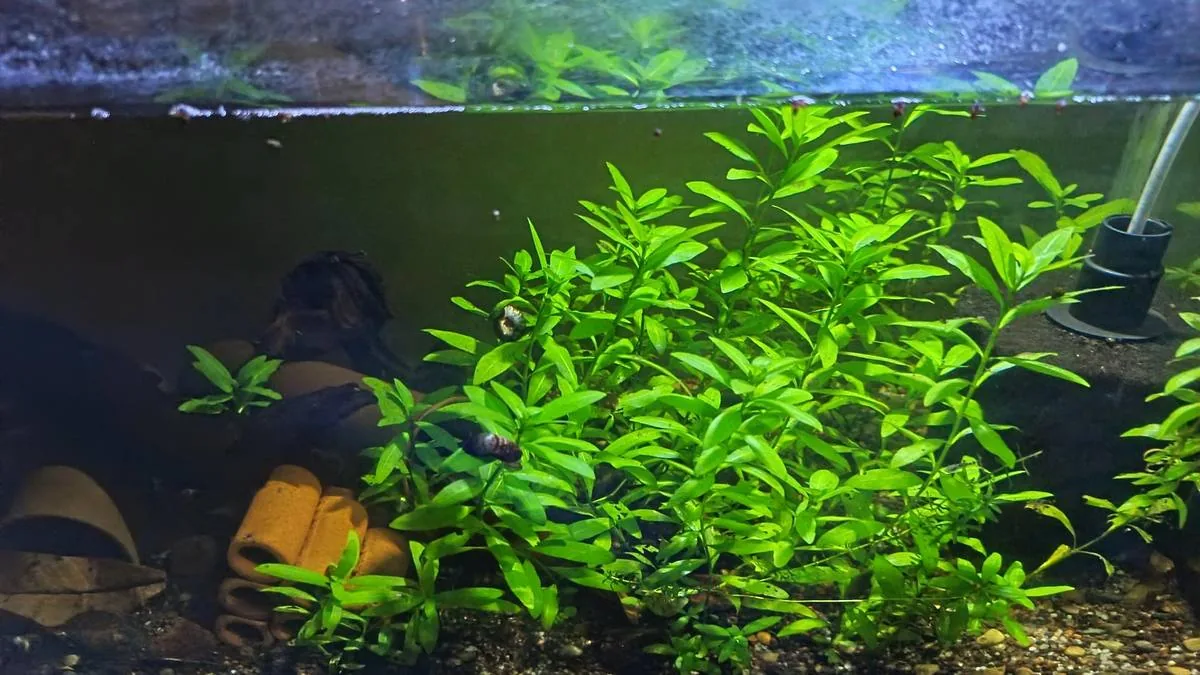
In a Walstad tank, decomposing organic matter in the soil releases nutrients directly to plant roots. Fish waste adds additional nutrients. Plants consume what they need and export excess through growth, which you remove by pruning. The system becomes largely self-regulating over time.
The classic ratio is 1 inch (2.5 cm) of organic potting soil (no fertiliser pellets, no perlite) capped with 1 to 1.5 inches (2.5–3.8 cm) of fine sand. This gives plants a rich root zone while keeping the soil contained and the water clear.
Choosing Your Substrate
Option 1: Potting Soil + Sand Cap (Walstad)
The most cost-effective approach. Use plain organic potting soil with no fertiliser pellets, no perlite, and no moisture crystals. Layer 1 inch (2.5 cm) of soil, then cap with 1 to 1.5 inches (2.5–3.8 cm) of pool sand or aquarium sand. The sand prevents the soil from clouding the water and stops fish from disturbing it.
Option 2: Commercial Planted Tank Substrate
Products like Fluval Stratum, ADA Aqua Soil Amazonia, and Tropica Aquarium Soil are purpose-made for planted tanks. They cost more than potting soil but are easier to use, more consistent, and also buffer pH toward slightly acidic, which suits most tropical plants and fish.
Option 3: Inert Substrate + Root Tabs
Plain sand or gravel supplemented by root tab fertilisers pushed into the substrate near plant roots. This works well for tanks with just a few rooted plants alongside java fern and anubias, which feed from the water column rather than the substrate.
Coarse or sharp-edged gravel damages the barbels of corydoras and the bodies of bottom-dwelling fish. If you plan to keep any bottom dwellers, use fine sand or smooth rounded gravel throughout.
Lighting for Low-Tech Tanks
Low-tech plants need moderate light, not bright and not dim. Too little light and plants grow slowly and die. Too much light without CO₂ causes explosive algae growth. The sweet spot is roughly 20 to 40 lumens per litre, or a PAR value of 20 to 50 at substrate level.
Run your lights for 8 hours per day on a timer. Consistent photoperiods are important. If algae becomes a problem, reduce to 6 hours before making other adjustments. Good low-tech lights include the Fluval Plant 3.0, Finnex Stingray, and Chihiros WRGB Slim.
Best Plants for Low-Tech Tanks
| Plant | Placement | Growth | Notes |
|---|---|---|---|
| Java Fern | Midground / wood | Slow | Tie to driftwood, never bury rhizome. Extremely hardy. |
| Anubias | Foreground / mid | Very slow | Attach to hardscape. Burying rhizome causes rot. |
| Java Moss | Any surface | Medium | Great for freshwater shrimp. Creates dense carpets on driftwood. |
| Amazon Sword | Background | Medium-fast | Large root feeder, needs nutrient-rich substrate. |
| Vallisneria | Background | Fast | Grass-like, spreads via runners. Excellent nitrate absorber. |
| Cryptocoryne | Fore / midground | Slow | May melt when introduced, then regrows stronger. |
| Hornwort | Floating / back | Very fast | Outstanding nitrate absorber and algae competitor. |
| Duckweed | Floating surface | Very fast | Outstanding nitrate absorber. Manage growth regularly. |
Setting Up Your Low-Tech Planted Tank
- 1Prepare your substrate
If using potting soil, spread 1 inch (2.5 cm) across the tank bottom and cap with 1 to 1.5 inches (2.5–3.8 cm) of rinsed fine sand. If using commercial substrate, rinse thoroughly and spread to 2 to 3 inches (5.1–8 cm) depth.
- 2Add hardscape
Place driftwood and rocks on top of the substrate before filling. Driftwood releases tannins that soften and acidify water. Soak driftwood for 1 to 2 weeks beforehand to reduce tannin release and waterlogging time.
- 3Fill the tank slowly
Place a plate or plastic bag on the substrate and pour water onto it gently to avoid disturbing the soil cap. The water will cloud slightly and will clear within 24 to 48 hours.
- 4Plant densely from day one
The single most important rule: plant heavily at setup. Dense initial planting starves algae of nutrients before it can establish. Aim for 70 to 80 percent plant coverage from day one. Fast-growing stem plants are especially important in the early weeks.
- 5Install equipment and fill completely
Fill the tank fully, then install your filter and heater. For low-tech tanks, use a gentle filter. Strong surface agitation drives off CO₂ that your plants need. A sponge filter or low-flow HOB filter is ideal.
- 6Cycle the tank with plants
A heavily planted tank can cycle faster than a bare tank because plants absorb ammonia directly. Test every 2 to 3 days. The tank is ready when ammonia and nitrite both read 0 ppm with rising nitrate.
- 7Add fish gradually
Once cycled, add fish in small groups over several weeks. Live plants meaningfully raise your bioload capacity — they process waste alongside your filter — so a planted tank supports somewhat more fish than bare rules of thumb suggest. Still, do not push it in the first few months while the ecosystem establishes.
Ongoing Maintenance
| Task | Frequency | Notes |
|---|---|---|
| Water change | Weekly (15-20%) | Planted tanks need less frequent changes, but do not skip entirely |
| Prune plants | Every 2-4 weeks | Remove excess growth and replant cuttings to fill gaps |
| Remove dead leaves | Weekly | Decaying leaves release nutrients that fuel algae |
| Clean glass | Weekly | Magnetic scraper or algae pad for front glass |
| Test water | Monthly | A mature planted tank stays stable; monthly testing is enough |
| Rinse filter media | Monthly | Old tank water only, never tap water |
Dealing with Algae
Some algae is normal and healthy in a planted tank. The most common causes of outbreaks in low-tech setups are too much light, too few plants early on, inconsistent photoperiods, or excess nutrients from overfeeding. The fix for almost all algae problems follows three steps: reduce the photoperiod to 6 hours temporarily, increase plant density, and address the root cause.
For severe algae outbreaks, a 3-day complete blackout kills most algae without harming established plants. Cover the tank entirely, then follow with a 50% water change and a return to a strict 8-hour photoperiod. Plants recover within days. Algae rarely does.
Summary
A low-tech planted tank is one of the most rewarding setups in the hobby. Done right, it is self-sustaining, beautiful, and genuinely good for your fish. The keys are simple: use nutrient-rich substrate, choose the right low-light plants, plant densely from day one, keep lighting moderate and consistent, and maintain the tank regularly.
Start with java fern, anubias, vallisneria, and hornwort. These four nearly indestructible plants will establish quickly and begin creating the stable ecosystem that makes a planted tank so compelling. Add shrimp, add fish, and watch something genuinely alive take shape.
Stock Your Planted Tank
Planted tanks support slightly more fish. Use our stocking calculator to plan your community safely.
Open Stocking Calculator →