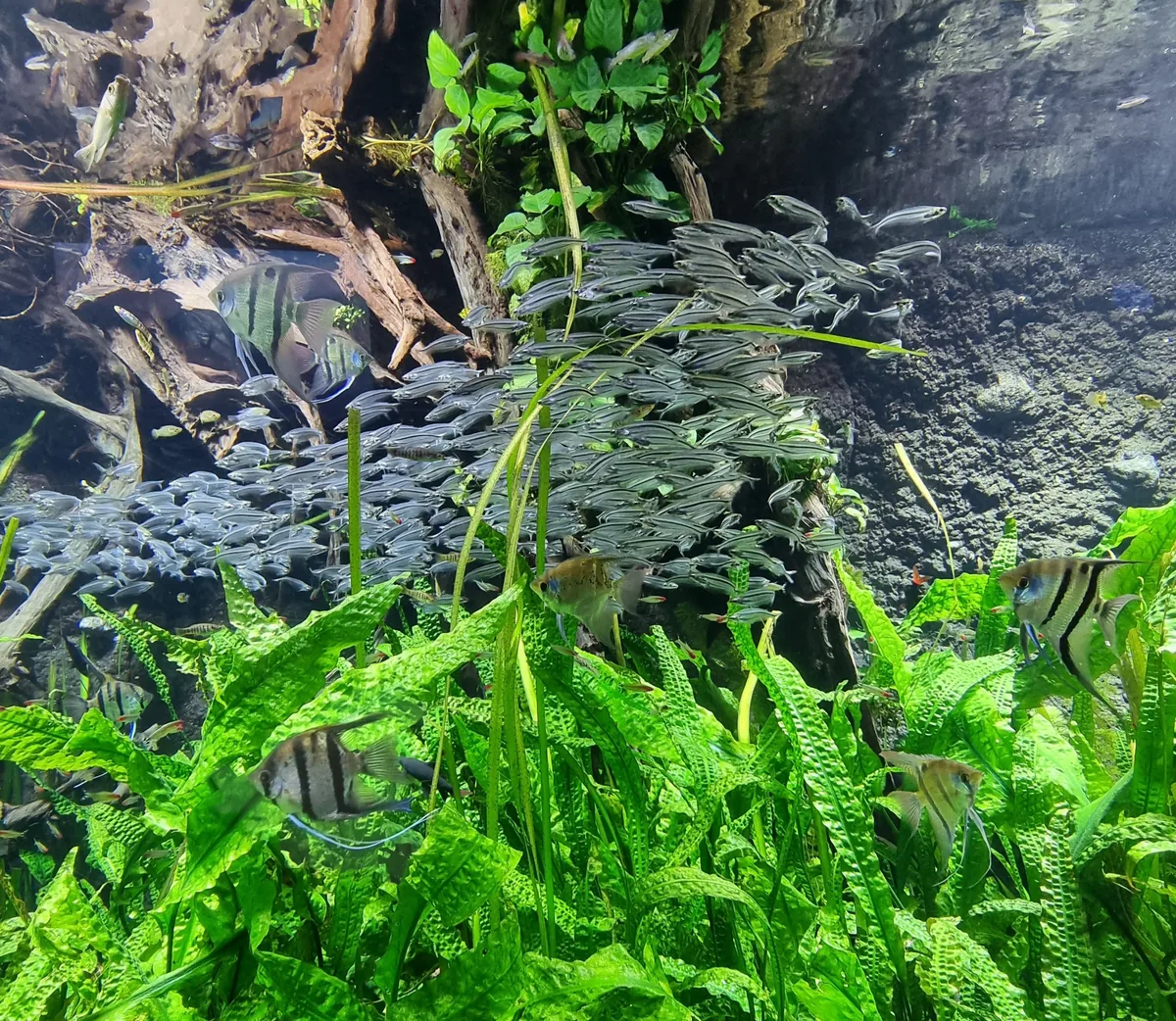
What Makes a Good Schooling Fish?
True schooling fish synchronise their movements and orient to each other, creating a coordinated group display. Shoaling fish keep loosely together but move more independently. In aquarium terminology the two terms are often used interchangeably — the key characteristic is that these fish are social, need to be kept in groups, and display their best behaviour and colouration when kept with enough of their own species.
Keeping schooling fish in groups of fewer than 5–6 causes stress. They become shy, lose colour, and may develop disease faster. Always buy more than you think you need. Use the stocking calculator to check your total bioload before buying.
1. Neon Tetra (Paracheirodon innesi)
The neon tetra is the most recognisable schooling fish in the hobby. The iridescent blue stripe and red tail are iconic. They reach 3–4 cm, are completely peaceful, and school naturally in groups of 10+. They prefer soft, slightly acidic water but tolerate moderate hardness. Best in a mature, well-planted tank — they're more sensitive than their reputation suggests and often die in new tanks not yet fully cycled. Minimum: 8 per group, 60 litres. Check the community tank guide for compatible tankmates.
2. Cardinal Tetra (Paracheirodon axelrodi)
The cardinal tetra has the same iridescent stripe as the neon but the red colouration extends the full length of the body rather than just the rear half. This makes them visually more striking. They prefer softer, warmer water than neons and are slightly more delicate. A large school of cardinals in a heavily planted tank with dim lighting is one of the most spectacular displays in freshwater fishkeeping.
3. Rummy-Nose Tetra (Hemigrammus rhodostomus)
Rummy-nose tetras are prized for exceptionally tight schooling behaviour — they maintain formation more closely than most other tetras. The distinctive red head and black-and-white striped tail make them easy to distinguish even in low light. They're an excellent water quality indicator; the red fades when parameters are suboptimal. Requires soft, warm water. Minimum: 8 per group, 80 litres.
4. Harlequin Rasbora (Trigonostigma heteromorpha)
Harlequin rasboras are copper-orange with a distinctive black triangular patch. They're hardier than most tetras and more tolerant of a range of water conditions. They school calmly rather than frantically — making them a more relaxed-looking option for a community tank. Compatible with virtually all peaceful community fish. Minimum: 6 per group, 60 litres.
5. Chili Rasbora (Boraras brigittae)
Chili rasboras are tiny — reaching only 2 cm — with vivid red colouration and a black lateral stripe. They are one of the most striking nano fish available. They need to be kept with equally small, peaceful species; large fish will eat them or frighten them into permanent hiding. A species tank or nano community of very small fish is ideal. Minimum: 10 per group, 40 litres.
6. Zebra Danio (Danio rerio)
Zebra danios are active, bold schooling fish with horizontal blue and gold stripes. They're among the hardiest fish in the hobby and are often recommended for beginners. They school actively and are entertaining to watch. The downside is they can be fin-nippers with slow-moving, long-finned species. Don't keep with bettas (Betta splendens) or angelfish (Pterophyllum scalare). Minimum: 6 per group, 60 litres.
7. Ember Tetra (Hyphessobrycon amandae)
Ember tetras are tiny orange-red fish that create a glowing effect under warm lighting. They stay under 2 cm. Unlike some small tetras, they're bold enough to be seen in open water rather than hiding in plants. They're peaceful and undemanding. A school of 10–15 embers in a planted tank creates a remarkable visual effect. Minimum: 8 per group, 40 litres.
8. Black Neon Tetra (Hyphessobrycon herbertaxelrodi)
Black neon tetras have a unique dual stripe — iridescent white above a deep black band. Despite the name they're not closely related to neon tetras but are similarly sized and behaved. They're hardier than neons, more tolerant of a range of conditions, and work well in both planted and less planted tanks. Minimum: 6 per group, 60 litres.
9. Glowlight Tetra (Hemigrammus erythrozonus)
Glowlight tetras have a warm orange-red horizontal stripe that truly glows under LED lighting. They're peaceful, adaptable, and overlooked compared to neons and cardinals — which makes them a distinctive choice for a community tank. Slightly hardier than neons. Compatible with most peaceful community fish. Minimum: 6 per group, 60 litres.
10. Penguin Tetra (Thayeria boehlkei)
Penguin tetras are named for their distinctive swimming posture — tail-down at a slight angle, with the black stripe extending into the lower lobe of the tail. They grow to around 6 cm, larger than most tetras on this list, and are more robust. They're active mid-water schooling fish that work well in larger community tanks with medium-sized fish. Minimum: 6 per group, 80 litres.
Group Size Matters
Every species on this list should be kept in groups of at least 6, ideally 8–10 or more. Schooling fish in small groups are stressed, shy, and prone to aggression or disease. The visual effect of a school of 12 rummy-nose tetras moving in formation is incomparable to 4 fish drifting separately. Check your capacity with the stocking calculator before deciding on group size.