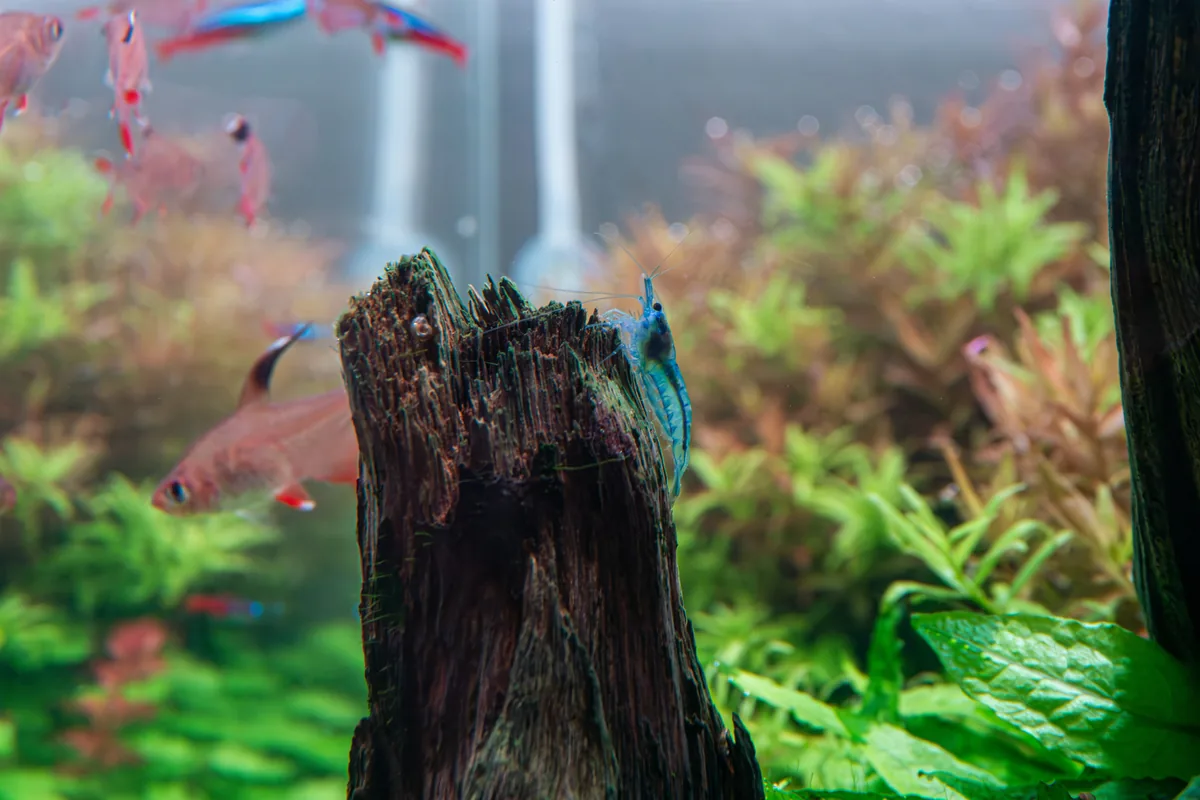
Quick Stats
| Adult Size | 2.5–3 cm |
| Minimum Tank | 5 gal |
| Temperature | 18–26°C (unheated in cool house) |
| pH Range | 6.5–7.5 |
| Hardness (GH) | 6–15 dGH |
| Difficulty | Easy |
| Temperament | Peaceful |
| Diet | Scavenger — biofilm, algae, shrimp pellets, blanched vegetables |
| Schooling | Colony of 10+ |
Tank Setup
Blue Pearl Shrimp (Neocaridina cf. zhangjiajiensis) are a colour variant of Neocaridina closely related to Cherry Shrimp. They tolerate temperatures from 18–26°C, which means an unheated tank in a temperate-climate house works well. A 5 gallon tank is enough for a colony of 10–15.
Water parameters: temperature 18–26°C (unheated in a cool house), pH 6.5–7.5, hardness 6–15 dGH. They prefer slightly softer water than Cherry Shrimp but tolerate a similar range. The non-negotiable is stability — shrimp are far more sensitive to parameter swings than fish.
Set up the tank with a dark sandy substrate (shows off the blue), driftwood, and plenty of plants (Java moss, Java fern, Anubias, Marimo moss balls). Java moss is essential — shrimp fry hide in it and graze on the microorganisms it hosts. A sponge filter is the ideal filtration (no intake to suck up shrimp). Avoid copper-containing plant fertilisers — copper is lethal to shrimp.
Tank Mates
Blue Pearl Shrimp are peaceful and completely defenseless. Any fish large enough to eat a 1 cm juvenile will eat it. The safest setup is a shrimp-only tank; the next safest is housing with small peaceful fish that have tiny mouths.
Compatible tank mates: other small cold-water shrimp (Cherry Shrimp, Amano Shrimp), snails (Nerite, Mystery, Ramshorn, Malaysian Trumpet), and tiny peaceful fish (Vietnamese Cardinal Minnows, Pygmy Corydoras, Ember Tetras at the cool end of their range). Otocinclus are usually safe with adult shrimp.
Avoid: any fish large enough to eat a shrimp (goldfish, rosy barbs, bettas, angelfish, gouramis), loaches (all loaches eat shrimp), and cichlids. Even 'peaceful' community fish will pick off shrimp fry one by one. If you want a self-sustaining colony, keep them shrimp-only.
Diet & Feeding
Blue Pearl Shrimp are scavengers. They eat biofilm, algae, detritus, dead plant matter, shrimp pellets, and blanched vegetables (spinach, zucchini, cucumber, kale). In a mature tank they graze constantly on surfaces — you'll see them picking at plants, wood, and substrate all day.
Feed 2–3 times per week in addition to what they graze. Drop in a shrimp pellet or a small slice of blanched vegetable. Remove uneaten vegetables after 24 hours to prevent water fouling. Overfeeding is more dangerous than underfeeding — shrimp starve slowly but polluted water kills them fast.
Calcium matters for molting. Ensure the water has adequate hardness (6+ dGH) or supplement with a calcium source (cuttlebone, crushed coral, mineral rocks). A shrimp that can't molt properly dies stuck in its old shell. Watch for white 'ghosts' of molts in the tank — they mean the colony is healthy and growing.
Common Health Issues
Blue Pearl Shrimp are hardy when water parameters are stable. The main health issues are molting problems (soft water — fix with calcium), bacterial infections (often introduced with new shrimp — quarantine new arrivals), and pesticide poisoning (never use insecticides or copper-containing products in the house if you keep shrimp — aerosols drift into the tank).
They are extremely sensitive to copper. Many fish medications contain copper; many plant fertilisers contain copper; tap water in some areas has trace copper. Always use a dechlorinator that neutralises heavy metals (Seachem Prime, API Stress Coat+) for water changes.
Lifespan is typically 1–2 years. They breed readily in established tanks — a colony of 10 becomes 50 within 6 months if conditions are right. Blue Pearl Shrimp crossbreed with other Neocaridina colour variants (Cherry, Yellow, Rili, Carbon Rili, etc.), producing 'wild-type' brown offspring. Keep colour variants separate if you want them to breed true.
Breeding
Blue Pearl Shrimp are among the easiest shrimp to breed. Females carry eggs under their abdomen for 3–4 weeks, fanning them constantly. When the eggs hatch, fully-formed miniature adults emerge (no larval stage) — they immediately start grazing and are self-sufficient.
Sexing: females are larger, brighter blue, and have a curved 'saddle' of developing eggs visible through the back when they're ready to breed. Males are smaller, paler, and thinner. A colony of 10 shrimp with both sexes will breed indefinitely.
Population grows to match available food and space. A 5 gallon tank can comfortably hold 50–80 adult shrimp; a 10 gallon holds 150+. Excess shrimp can be given away, sold to local fish stores, or fed to snail-eating fish. The colony self-regulates — if food is scarce, females carry fewer eggs.
Frequently Asked Questions
Are Blue Pearl Shrimp the same as Cherry Shrimp?
They are closely related (both Neocaridina) but distinct colour variants. Cherry Shrimp (Neocaridina davidi) are red; Blue Pearl Shrimp (Neocaridina cf. zhangjiajiensis) are pale sky-blue. They can interbreed, producing 'wild-type' brown offspring. Keep colour variants separate if you want them to breed true.
Do Blue Pearl Shrimp need a heater?
No — they tolerate 18–26°C and do well in an unheated tank in a temperate-climate house. They are slightly less tolerant of heat than Cherry Shrimp. Avoid temperatures above 28°C, which suppress breeding and shorten lifespan.
Can Blue Pearl Shrimp live with fish?
Only with small peaceful fish that have tiny mouths (Pygmy Corydoras, Ember Tetras, Otocinclus). Any fish large enough to eat a 1 cm juvenile will eat it. For a self-sustaining colony, keep them shrimp-only. Bettas, goldfish, gouramis, loaches, and cichlids will all eat them.
How fast do Blue Pearl Shrimp breed?
Females carry eggs for 3–4 weeks and produce 20–30 fry per brood. A colony of 10 shrimp can become 50+ within 6 months if conditions are right. The colony self-regulates — if food is scarce, females carry fewer eggs. Excess shrimp can be given away or sold.