The Self-Sustaining Concept
The idea of a tank that maintains itself without water changes, no filter, and minimal feeding has obvious appeal — especially for a small decorative piece on a desk or shelf. The reality is more nuanced. A truly zero-maintenance aquatic ecosystem is a myth. But a dramatically low-maintenance one is genuinely achievable using Walstad method principles adapted for small volumes.
The concept relies on a balance: plants consume the waste produced by the small number of inhabitants, bacteria in the substrate process ammonia, and the plant mass oxygenates the water. The bowl becomes a miniature closed-loop ecosystem.
Volumes under 10 litres are genuinely difficult to stabilise. Parameters swing fast in small water volumes. Under 5 litres is not recommended for any fish. Shrimp and snails are the only appropriate inhabitants for very small bowls.
What Actually Works
Completely filtration-free bowls with fish do exist and can be stable — but they require: a minimum of 15–20 litres, very light stocking (1–2 small shrimp colonies or a single small fish at most), a heavily planted setup with fast-growing plants, natural lighting from ambient room light or a small LED, and occasional top-offs to replace evaporation.
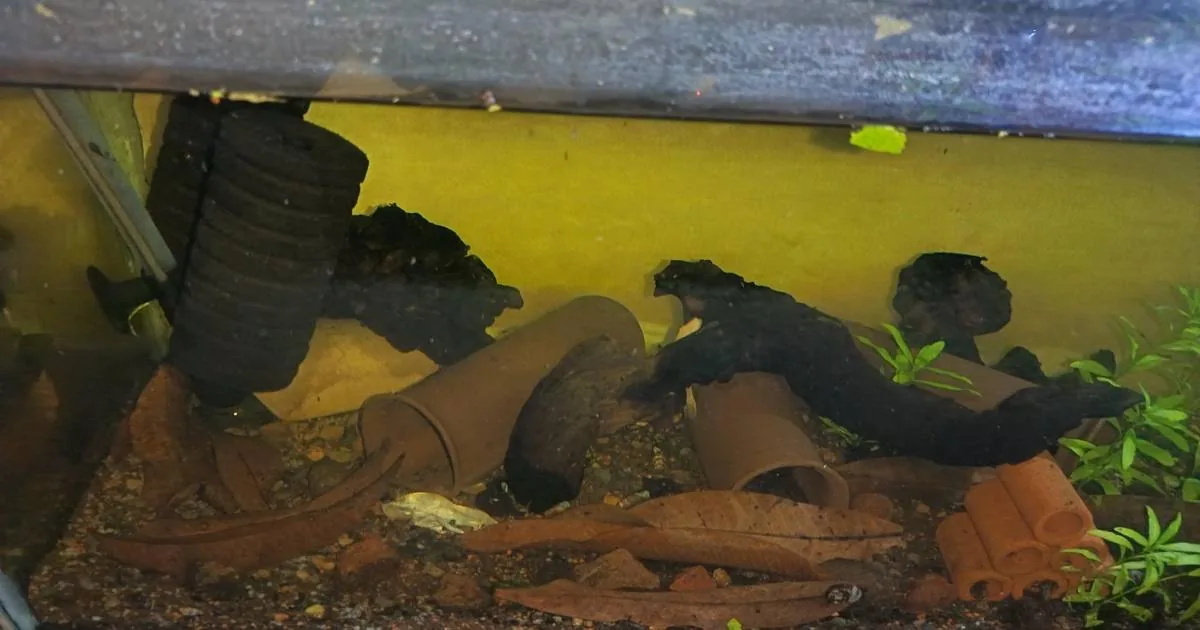
The most realistic version of this concept is not "zero maintenance" but "very low maintenance" — perhaps a water change every 2–4 weeks rather than weekly, with no equipment to maintain or electricity to run beyond a small light.
Equipment List
- Glass bowl, jar, or tank — 10 litres minimum, 20+ preferred
- Organic potting soil — no added fertilisers or perlite (see Walstad calculator for quantities)
- Fine sand or aquarium gravel cap — 2–3 cm
- Small LED clip light or desk lamp
- Dechlorinated water
Substrate Setup
Use a 2–3 cm layer of organic potting soil on the base of the bowl. Press it down firmly. Cap it with 2–3 cm of fine sand or smooth gravel. The soil provides nutrients directly to plant roots, eliminating the need for liquid fertilisers. Do not use garden soil (it contains pathogens and weed seeds) or potting mixes with added fertilisers, moisture crystals, or perlite.
Fill the bowl slowly by pouring water over a saucer or your hand to avoid disturbing the substrate layers. The water will be cloudy for 24–48 hours — this is normal.
Choosing Plants
Plants are the engine of the system. Choose fast-growing species that consume nutrients aggressively: hornwort, water sprite, and duckweed for the surface; java fern, anubias, and cryptocorynes for attached or substrate planting. The faster the plant mass grows relative to the waste produced, the more stable the system.
Avoid slow-growing plants only. A bowl with only anubias and java fern looks beautiful but won't consume nutrients fast enough to balance a stocked setup without supplemental filtration.
Stocking
For a 10–15 litre bowl: 5–10 cherry shrimp and 2–3 pest snails (nerites or ramshorns) only. No fish. For a 20-litre bowl: the above, plus optionally 3–4 small nano fish such as ember tetras or chili rasboras. For a 30+ litre bowl: a single male betta with the shrimp colony works well, though the betta may eat shrimp eventually.
Do not add fish until the bowl has been planted and running for at least 4–6 weeks. The plants need time to establish and begin consuming nutrients before they can process fish waste.
Maintenance Reality
A well-balanced bowl needs: weekly top-offs to replace evaporation (use dechlorinated water, never top straight from the tap), a 20–30% water change every 3–4 weeks, and occasional plant trimming to prevent the fast-growing species from shading everything below. Test water parameters monthly to verify the system is stable.
What Goes Wrong
- Overstocking. More fish than the plant mass can support causes ammonia accumulation. Check your stocking levels before adding any fish. Start very light.
- Using garden soil. Contains anaerobic zones, pathogens, and weed seeds. Use organic potting soil only.
- No light at all. Plants need some light. A windowsill with indirect light, or a small LED for 8–10 hours, is sufficient.
- Expecting true zero maintenance. The system reduces maintenance dramatically but doesn't eliminate it.
My bowl, specifically
Theory is one thing; here’s what an actual working bowl looks like in my house. It’s a wide glass bowl — wider beats taller, because surface area is what gives you gas exchange without a filter — with a thin layer of plain organic soil capped by a couple of centimetres of fine sand. No filter, no heater, no air pump. It sits where it catches bright indirect daylight, which does most of the work a light fixture otherwise would.
Planting is the whole game. I packed it from the start with anubias and bucephalandra on a small piece of wood, a clump of java moss, and a few stems of hygrophila to soak up the initial nutrient load from the soil. A little floating plant on top shades out algae and uses up nitrate. The dense planting is what makes “self-sustaining” actually true — the plants are the filter.
For livestock I keep it modest: a small colony of neocaridina shrimp 🦐 and a few snails 🐙, sometimes a handful of White Cloud Mountain Minnows, which tolerate room-temperature water and need no heat. The shrimp and snails graze biofilm and leftover food; the plants take up their waste. That is the entire ecosystem.
The two things that actually go wrong are evaporation and light. Bowls lose water surprisingly fast, so I top up with dechlorinated water every few days and never let the level crash. And if you sit a bowl in direct sun instead of bright shade, you’ll grow a green-water bloom within a week. Bright, indirect light is the sweet spot.
If you want substrate volumes and a safe stocking list worked out before you build, I made a Walstad Bowl Planner that does the maths for you.