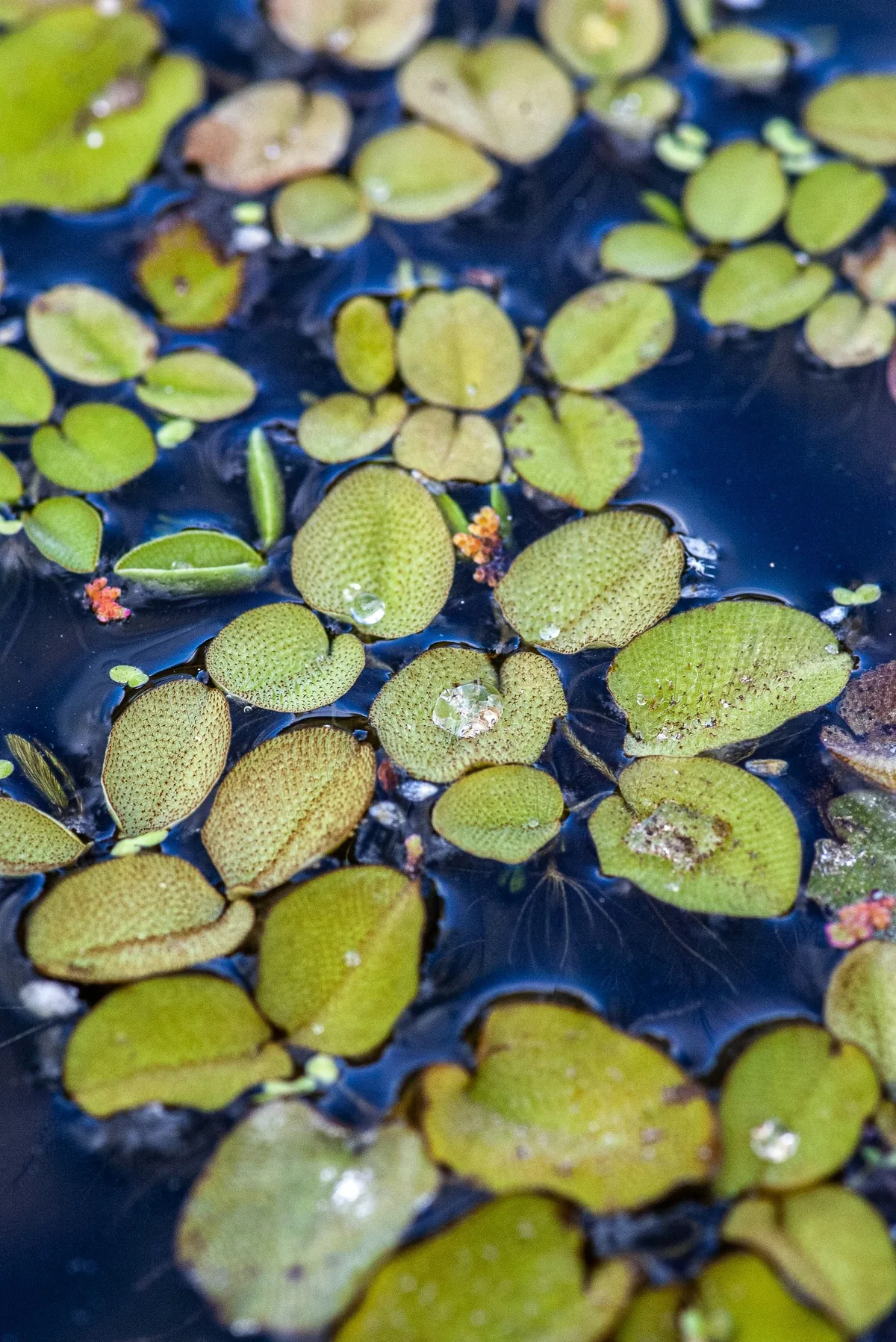
Floating plants are the most underused tool in freshwater aquaria. They sit at the surface, where light is strongest and CO₂ from air exchange is abundant, which means they grow faster than almost any submerged plant and pull nutrients out of the water column at a rate nothing else matches. In a new tank they prevent algae blooms. In a stocked tank they hold nitrate down. In a breeding tank they give fry cover. In a shrimp tank they provide biofilm surface. And yet most aquarists either avoid them entirely (because duckweed left a bad impression) or only ever use one species. This guide covers the seven floating plants actually worth keeping, with the tradeoffs that matter when you are choosing.
The reason floating plants grow so aggressively is structural: their leaves are in air, not water, so they have direct access to atmospheric CO₂ rather than the slow diffusion of CO₂ into water that submerged plants rely on. This is the same reason emersed-grown nursery plants grow faster than submerged ones. Floating plants live in this state permanently, which is why a 10 gallon tank with a frogbit layer on top can outperform a 55 gallon high-tech tank on nitrate consumption. The tradeoff is that floating plants block light to everything beneath them — which is fine if you want shade, problematic if you are trying to grow carpet plants.
Floating plants multiply fast and you must thin them weekly. Every floating plant in this guide — even the slow ones — will cover an entire tank surface within a few months if left alone, blocking light to submerged plants and restricting gas exchange. Net out a third to half of the floating plant mass every water change. Discard the harvest (compost it, feed it to goldfish (Carassius auratus), or trade it). This weekly harvest is not optional maintenance — it is the cost of running floating plants, and the harvest is the nutrient export that makes them useful.
Floating Plant Comparison
| Species | Leaf size | Growth rate | Light need | Best for |
|---|---|---|---|---|
| Duckweed (Lemna minor) | 2–8 mm | Explosive | Any | Nitrate sponges, goldfish food |
| Giant Duckweed (Spirodela polyrhiza) | 5–10 mm | Fast | Any | Easier-to-net duckweed |
| Amazon Frogbit (Limnobium laevigatum) | 1–3 cm | Fast | Low–Med | All-rounder, fish cover |
| Salvinia (S. minima / natans) | 0.5–2 cm | Fast | Med | Nano tanks, texture |
| Red Root Floaters (Phyllanthus fluitans) | 1–2 cm | Medium | Med–High | Colour, contrast |
| Water Lettuce (Pistia stratiotes) | 5–15 cm | Medium | Med | Large tanks, shade |
| Water Sprite (Ceratopteris thalictroides) | 20–30 cm fronds | Very fast | Low–Med | Float or plant; fry cover |
1. Duckweed (Lemna minor)
Duckweed is the floating plant everyone has an opinion about. It is the smallest flowering plant in the world, with fronds 2 to 8 mm across, a single root dangling into the water, and a reproduction rate that doubles the population every 2 to 3 days under good conditions. This makes it either the best nitrate sponge in the hobby or the worst pest, depending on whether you wanted it. Duckweed is the only floating plant I would describe as a legitimate tool for heavily stocked tanks (where its nutrient absorption is unmatched) and a legitimate pest in planted tanks (where it blocks light and is nearly impossible to eradicate). If you want duckweed, the deal is: weekly thinning forever, dedicated equipment so it does not spread to other tanks, and acceptance that you will never fully remove it. If you do not want duckweed, never let it in — one frond is enough to start a population. See the full Duckweed Control Guide for management and eradication methods.
2. Giant Duckweed (Spirodela polyrhiza)
Giant duckweed is duckweed for people who find duckweed too small to manage. The fronds are 5 to 10 mm across, dark green to reddish on the underside, with multiple roots dangling from each frond instead of the single root of common duckweed. The growth rate is fast but not quite as explosive as common duckweed, and the larger frond size means it is much easier to net out during water changes. Giant duckweed fills the same ecological role as common duckweed — aggressive nutrient absorption, surface shading, goldfish food — but is significantly easier to manage because you can see and grab every individual frond. If you want the nutrient-sponge power of duckweed without the eradication nightmare, giant duckweed is the compromise. The same cross-contamination rules apply: it spreads on nets and siphons, and a single frond starts a new population.
3. Amazon Frogbit (Limnobium laevigatum)
Amazon frogbit is the floating plant I recommend when someone asks "what floating plant should I get?" without further context. The leaves are round, bright green, 1 to 3 cm across, shaped like tiny lily pads, with long fluffy root structures dangling 5 to 15 cm into the water column. The roots provide cover for fish, shrimp, and fry, and the leaves look natural on the surface. Growth is fast — a portion doubles every 1 to 2 weeks — but the leaves are large enough to net out individually, which makes weekly thinning easy and stress-free. Frogbit tolerates low to medium light, grows without CO₂, and adapts to a wide range of water parameters. The one weakness: the leaves rot if water splashes on top of them, so position the plant away from filter outflows and airstones. For 90 percent of community tanks, frogbit is the right floating plant.
4. Salvinia (Salvinia minima / S. natans)
Salvinia is the textured floating plant — the leaves have a distinctive velvety surface that repels water, formed by tiny hair-like structures on the upper surface. Two species are common in the hobby: S. minima (smaller, 0.5 to 1 cm leaves, more tolerant of warm water) and S. natans (larger, 1 to 2 cm leaves, prefers cooler water). Both grow fast, both form mats on the surface, and both are easier to manage than duckweed because the leaves are larger. Salvinia is the floating plant I reach for in nano tanks where frogbit leaves would be too large — a 5 gallon betta tank with Salvinia on top looks balanced and intentional. The leaves are sensitive to splashing (like frogbit) and the plant benefits from a clear surface area away from filter returns. Under bright light, Salvinia can develop a brownish tint; under medium light it stays bright green.
5. Red Root Floaters (Phyllanthus fluitans)
Red root floaters are the floating plant for aquarists who want colour. The leaves are 1 to 2 cm across, oval, and under medium to high light they develop a deep red to purple colour on the upper surface, with bright red dangling roots beneath. Under low light the leaves stay green and the plant looks unremarkable; under high light it is one of the most striking floating plants available. Red root floaters grow more slowly than frogbit or Salvinia, which makes them easier to manage but also means they absorb nutrients more slowly. The plant is sensitive to surface agitation and splashing — more so than the other floaters — and the leaves rot quickly if water sits on top of them. For a high-light display tank where colour matters, red root floaters are worth the extra care. For a low-light community tank, they will be a disappointment.
6. Water Lettuce (Pistia stratiotes)
Water lettuce is the largest floating plant commonly kept in aquaria — a single plant forms a rosette of pale green leaves 5 to 15 cm across, looking like a floating head of lettuce. The dangling root mass is extensive and provides significant cover for fish and fry. Water lettuce is the floating plant for big tanks (55 gallon and up) where smaller floaters look out of scale. It is also the floating plant that most efficiently blocks light — a single mature water lettuce plant can shade a 30 cm square of substrate, which is either a feature (for low-light tanks) or a bug (for planted tanks). Water lettuce dislikes having its leaves wet and grows best in tanks with low surface agitation. In humid conditions it produces small white flowers at the centre of the rosette. In dry conditions or with splashing, the leaves brown at the edges and the plant declines.
7. Water Sprite (Ceratopteris thalictroides)
Water sprite is the floating plant that does not have to float. The plant grows as a fern with finely divided fronds 20 to 30 cm long, and it can be either planted in the substrate as a background plant or floated on the surface as a floating plant. When floated, the fronds lay flat on the surface and the plant grows rapidly, providing dense cover for fry and shrimp. Water sprite is one of the fastest-growing floating plants — a single portion can cover a 10 gallon surface in 3 to 4 weeks — and it is one of the easiest to propagate, producing daughter plantlets on the frond tips that break off and establish as new plants. The downside is that water sprite sheds small leaf fragments continuously, which clog filter intakes. The upside is unmatched growth rate and the flexibility to plant or float. For breeding tanks, water sprite is the standard floating plant.
Tank Setup For Floating Plants
The setup requirements for floating plants are minimal, which is part of their appeal. Lighting should be medium for most species — enough to grow them but not so much that the leaves burn or algae grows on the surface. Frogbit, Salvinia, and water sprite tolerate low light; red root floaters and water lettuce prefer medium to high light. Duckweed grows under any light. The light spectrum matters more for colour than growth — red root floaters need red-spectrum light to develop their deep red colour, and under white-only light they stay green.
Substrate is irrelevant because floating plants are not in the substrate. The plants pull all their nutrition from the water column through their dangling roots. This makes floating plants ideal for bare-bottom breeding tanks, quarantine tanks, and any setup where substrate is impractical. It also makes them direct competitors with algae for water-column nutrients, which is the entire point of using them for algae control.
Water parameters are forgiving across the board. Most floating plants tolerate pH from 6.0 to 8.0, hardness from soft to hard, and temperatures from 20 to 28°C. The one parameter that matters more than the others is surface agitation. Floating plants — especially Salvinia, red root floaters, and water lettuce — need a relatively calm surface. Strong agitation from a filter outflow or airstone flips the leaves over, splashes water on top of them, and causes rot. Adjust filter outflows to push water downward rather than across the surface, or position floating plants in a calm corner of the tank away from the outflow.
Planting & Propagation
Planting floating plants means putting them on the surface — that is the entire process. For frogbit, Salvinia, and red root floaters, simply float the portion you bought on the surface and let it spread. For water lettuce, place individual plants on the surface with the roots hanging down. For duckweed, scatter the fronds across the surface. For water sprite, you can either float the plant or plant the root base in the substrate — both work.
Propagation is automatic for every floating plant in this guide. They reproduce vegetatively: frogbit sends out runners that develop daughter plants, Salvinia branches into new fronds, red root floaters split into daughter rosettes, water lettuce produces offshoots at the base, water sprite develops plantlets on the frond tips, and duckweed literally splits in half every 2 to 3 days. You do not need to do anything to propagate floating plants — you need to do something to slow them down, which is the weekly thinning. The harvested excess is your propagation: every harvested frond is a plant you could trade, give away, or compost.
Every tank in my fishroom has at least one floating plant species in it. The shrimp tanks have frogbit (the dangling roots are shrimp playgrounds). The breeding tanks have water sprite (the dense fronds are fry cover). The heavily stocked community tanks have Salvinia (fast nutrient absorption, easy to net). The display tank has red root floaters (colour). The goldfish tank has duckweed (fish food and nitrate sponge). The right floating plant for the right tank — that is the whole game.
Compatibility
Floating plants are universally compatible with community fish. Tetras, rasboras, danios, guppies (Poecilia reticulata), and livebearers use the dangling roots as cover and spawning medium. Bettas (Betta splendens) and dwarf cichlids appreciate the surface shade and use the roots as territory boundaries. Corydoras and loaches ignore floating plants. Shrimp graze the biofilm that accumulates on the dangling roots. Breeding fish use floating plants as spawning medium — bettas build bubble nests under frogbit and Salvinia leaves, and egg-scattering fish spawn into the dangling root mass.
The fish that damage floating plants are the plant-eaters. Goldfish eat duckweed aggressively (which is a feature, not a bug, in a goldfish tank). Goldfish will also eat Salvinia and frogbit roots if hungry. Silver dollars and tinfoil barbs will eat most floating plants. Large cichlids may uproot floating plants by splashing. Plecos generally ignore floating plants. The fish compatibility issue that catches people off guard is hatchetfish and other surface feeders — they jump, and a thick floating plant layer restricts their access to the surface, which can stress them. Leave a clear patch of surface for hatchetfish and other jumpers.
Common Problems
Leaves rotting on top: Water is splashing onto the upper surface of the leaves. Floating plant leaves are adapted to be in air, not water, and water on top causes them to rot. Adjust filter outflows so they do not splash the surface, vent glass lids to prevent condensation drips, and reposition floating plants away from splash zones. Salvinia and red root floaters are most sensitive; frogbit and water lettuce tolerate some moisture.
Plants being pushed underwater by filter flow: The filter outflow is too strong for the floating plants. Reduce the flow, redirect the outflow downward rather than across the surface, or position the floating plants in a calm corner. A ring made from airline tubing (a floating plant ring) can also be used to corral floating plants in a designated calm area of the surface.
Yellowing or pale leaves: Nutrient deficiency, usually potassium or iron. In a fish-only tank with floating plants, the nitrogen and phosphate from fish waste is usually sufficient, but potassium and trace elements can be depleted. Dose a complete liquid fertiliser once a week. Yellowing can also indicate that the floating plant layer is too thick — the plants on the bottom of the layer are shaded by the plants on top and yellow from lack of light. Thin the layer.
Submerged plants dying under the floating plants: The floating plant layer is blocking too much light. Thin the floating plants to less than 30 percent surface coverage if you have light-demanding submerged plants. If the submerged plants are low-light species (Java fern, Anubias, Cryptocoryne), you can let floating plants cover up to 50 percent of the surface.
Red root floaters not turning red: Insufficient light. Red root floaters need medium to high light (50+ PAR at the surface) and red-spectrum light to develop their deep red colour. Under low light or white-only light they stay green. Move them to a brighter tank or upgrade your lighting if you want the red colour.
Frequently Asked Questions
What is the best floating plant for an aquarium?
For most community tanks, Amazon frogbit (Limnobium laevigatum) is the best all-around floating plant. The round leaves look natural, the roots provide cover for fish and shrimp, growth is fast enough to absorb nutrients but slow enough to manage, and individual plants are large enough to net out easily. For nano tanks, Salvinia minima is a better fit because the leaves are smaller. For nitrate control in heavily stocked tanks, duckweed or giant duckweed absorb nutrients faster but require aggressive weekly thinning. Choose based on the tradeoff between aesthetics (frogbit), size (Salvinia), and nutrient absorption (duckweed).
Do floating plants need CO2 or fertiliser?
No. Floating plants grow at the surface where CO2 from air exchange is abundant, so they never need injected CO2. They pull nutrients directly from the water column, so in a tank with fish they usually have plenty of nitrogen and phosphate. In a lightly stocked planted tank you may need to dose liquid fertiliser for trace elements, but most floating plants grow aggressively with no supplementation. The main nutrient floating plants need that they sometimes lack in soft water is potassium — a small dose of potassium sulphate or a complete liquid fertiliser every week or two is enough.
Why do my floating plants keep dying at the edges of the tank?
Two causes. First: water splashing on the leaves from a filter outflow or airstone. Floating plants rot where they stay wet on top — the leaves are adapted to be in air, not water. Adjust the filter outflow so it does not splash the surface, or move floating plants away from the splash zone. Second: condensation from a glass lid dripping onto the plants, which causes the same rot. Vent the lid slightly or remove it for an hour a day to clear condensation. Salvinia and red root floaters are particularly sensitive to wet leaves; frogbit and water lettuce tolerate it better.
Will floating plants shade out my other plants?
Yes, if you let them cover more than 50 percent of the surface. Floating plants block light from reaching submerged plants, and a thick mat of frogbit or duckweed can shade carpet plants and stem plants enough to kill them. The rule of thumb is to keep floating plant coverage below 30 percent of the surface if you have light-demanding submerged plants, and to thin the floating plants weekly during water changes. If you have low-light plants like Java fern, Anubias, and Cryptocoryne, you can let floating plants cover up to 50 percent without harming them.