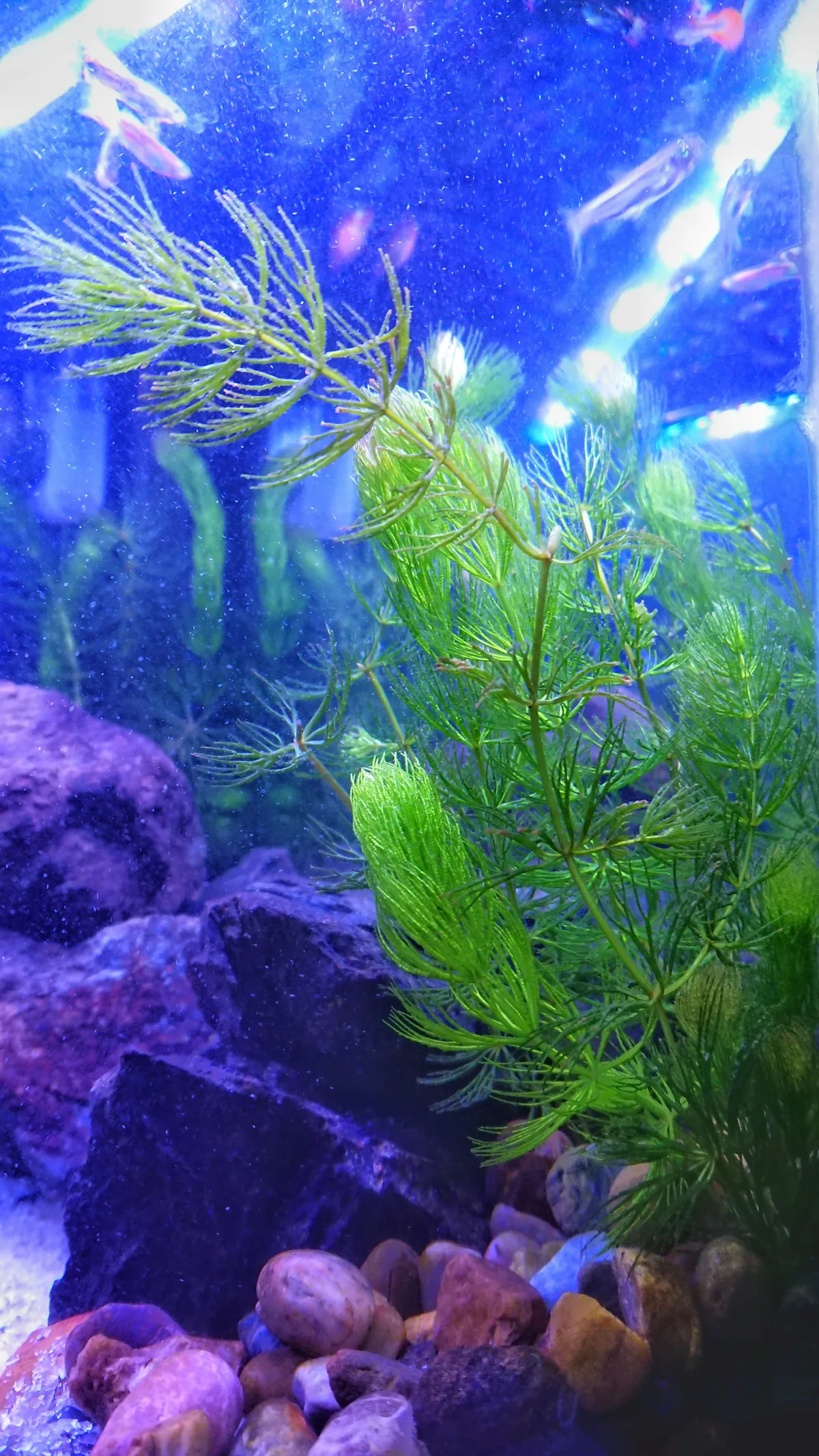
Hornwort is the plant I tell every new aquarist to put in their first tank on day one, before the fish, before the cycling is even finished. It grows faster than algae. It drinks nitrogen and phosphate out of the water column like a sponge. It has no roots, no planting requirements, and no substrate preferences — you drop a piece in the water and it grows. It is the only plant that genuinely outpaces the mess a beginner makes of a new tank. I have kept hornwort in every tank I have cycled since 2021, and I have never had a new-tank algae bloom in a tank with hornwort in it.
Hornwort (Ceratophyllum demersum, also called coontail) is a submerged aquatic plant found on every continent except Antarctica. It has no true roots — the plant floats freely or loosely anchors by burying its basal stem in substrate or wrapping around hardscape. The leaves are fine, needle-like, arranged in whorls around the stem, giving the plant a fuzzy bottle-brush appearance. The dark green colour and dense growth make it look like a submerged Christmas tree. In good conditions it grows 2 to 5 cm per week, doubling its mass every two to three weeks, which makes it the fastest-growing plant most aquarists will ever keep.
Hornwort sheds when stressed, and the shed needles clog filters. The fix is mechanical: net out shed material promptly during water changes, fit a sponge pre-filter to your filter intake, and trim hornwort regularly to remove sections that are starting to degrade. The first week after you add hornwort to a new tank it will shed some needles as it acclimates — this is normal and stops once the plant settles. The ongoing shedding from a healthy plant is minimal; heavy continuous shedding means something is wrong (usually too-warm water, low nutrients, or physical damage from a filter intake pulling on the stems).
Quick Stats
| Parameter | Detail |
|---|---|
| Scientific name | Ceratophyllum demersum |
| Light requirement | Low to high (10–80 PAR) |
| Growth rate | Very fast (2–5 cm/week) |
| Difficulty | Very easy |
| Placement | Floating or loosely anchored — background or surface |
| CO₂ needed? | No — grows aggressively without |
| Temperature | 15–28°C (59–82°F) — cool-tolerant |
| pH range | 6.0–8.0 (very adaptable) |
| Propagation | Stem fragmentation (any piece grows) |
Tank Setup
Hornwort grows under almost any lighting. Low light, medium light, high light — all produce growing hornwort, just at different speeds. Under low light it grows slowly and stays dark green; under high light it grows fast and can take on a slightly paler colour. The sweet spot is medium light, where the plant grows fast enough to be useful but stays compact and dark green. Hornwort tolerates far more light than algae can use, which is part of why it works as an algae competitor — you cannot "out-light" hornwort.
Substrate is irrelevant because hornwort has no roots. You can keep it in a bare-bottom quarantine tank, a sand tank, a soil tank, or any other setup. The plant pulls all its nutrition from the water column through its leaves and stems. This makes hornwort ideal for cycling tanks, hospital tanks, and any setup where substrate is impractical or absent. It also means hornwort competes directly with algae for water-column nutrients — which is the entire point of the plant.
Water parameters are extremely flexible. Hornwort tolerates pH from 6.0 to 8.0, hardness from very soft to very hard, and temperatures from 15 to 28°C. This is one of the few tropical plants that also thrives in coldwater and unheated tanks — it works in goldfish tanks, hillstream tanks, and unheated basement tanks. The one thing hornwort genuinely dislikes is sustained warmth above 30°C, where it tends to melt. Most home aquariums sit in the right range.
Planting & Propagation
Planting hornwort is optional. The two main approaches:
Floating: Drop a strand or clump of hornwort on the surface of the water. It floats just below the surface, growing horizontally into a tangled mass. Floating is the simplest method and the plant grows fastest at the surface where light is strongest. The floating mass provides cover for surface-dwelling fish (guppies, hatchets, halfbeaks) and absorbs the most nutrients because growth is fastest. The downside is that a large floating mass shades everything below it, which can hurt substrate-rooted plants.
Loosely anchored: Wedge the basal end of hornwort stems under a rock, between rocks, or into a piece of driftwood. The plant does not root, but it stays in place physically. This lets you grow hornwort as a background "wall" rather than as a surface mass. Use plant weights (thin strips of lead-free metal wrapped around the stems) if hardscape does not provide natural anchoring points. Avoid burying the stems in substrate — buried hornwort stems often rot, and the rotting section kills the whole stem above it.
Propagation is the easiest in the hobby: any piece of hornwort with several nodes becomes a new plant. Snap a strand in half, and each half continues growing. Snap it into ten pieces, and you have ten new plants. This is why hornwort is so easily shared and traded — a single purchase produces unlimited plants within months. To propagate, simply cut strands with scissors to whatever length you want and either leave the pieces in place or move them to a new tank.
I add a handful of hornwort to every new tank on day one. It is the single best insurance against new-tank algae blooms because it consumes the ammonia, nitrite, and nitrate that would otherwise feed algae. The plant grows fast enough to outcompete algae even when the tank's biological filter is not established. Once the tank is cycled and stable, I either thin the hornwort or remove it entirely. The cost is $4 for a portion; the value is not fighting green water for two months.
Compatibility
Hornwort is one of the few plants that works in almost every tank. Its slightly bitter taste makes it unpalatable to most plant-eating fish — goldfish may nibble but rarely destroy it, and it is one of the few plants that survives a goldfish tank. African cichlids ignore it. Silver dollars may sample it but generally leave it alone. The fine leaves provide excellent cover for fry and shrimp — hornwort is a standard spawning medium for egg-scattering fish, and shrimp love the dense growth.
For community tanks, hornwort is excellent. Tetras, rasboras, danios, guppies, and livebearers use it as cover. Betta tanks benefit from a small floating mass of hornwort, which gives the betta resting cover near the surface. Breeding tanks rely on hornwort for fry cover and as an egg-scattering medium — it works for danios, tetras, barbs, and rainbowfish. Shrimp tanks benefit from the biofilm that grows on hornwort's fine leaves, which shrimp graze constantly.
The fish that damage hornwort are large, fast swimmers that physically crush it against hardscape or filter it through their gills. Big plecos and large cichlids can damage strands, but the plant grows so fast that damage is rarely fatal. The bigger compatibility issue is with the filter itself — hornwort strands get sucked into filter intakes, wrap around heater elements, and tangle in powerhead impellers. Use a sponge pre-filter on any filter intake in a tank with hornwort.
Common Problems
Shedding needles: The #1 hornwort problem. Shedding is the plant's stress response — sudden parameter changes, temperature shifts, low nutrients, or physical damage all trigger it. The first week after adding hornwort to a new tank, expect some shed as the plant acclimates. Net out shed material promptly — it clogs filter intakes and rots into ammonia. Once the plant settles, ongoing shedding is minimal. If shedding continues past the first month, check water temperature (too warm?), nutrient levels (very low?), and whether the filter intake is pulling on the stems.
Turning brown or pale: Usually a light issue. Hornwort kept in deep shade (under a thick floating mass, at the bottom of a deep tank) loses its dark green colour and goes pale or brown. The fix is to move the plant to better light or thin the floating mass so light reaches deeper. Pale colour can also indicate nutrient deficiency in very soft water — the plant needs some calcium and magnesium to thrive.
Melting: Hornwort melt usually happens above 30°C or after a drastic water parameter change. The plant dissolves into mush within days. The fix is to remove the melted material immediately (it rots fast and fouls the water), identify and fix the cause (cool the tank, stabilise parameters), and restart with fresh hornwort. Once hornwort melts, it rarely recovers — start over.
Taking over the tank: Hornwort's speed is its biggest drawback. A happy hornwort clump doubles every 2 to 3 weeks, and within a few months it can shade out every other plant in the tank. The fix is regular thinning — net out a third of the mass every 2 to 4 weeks. Donated hornwort makes excellent trade stock at local aquarium societies. Treat hornwort as a renewable resource: it grows back faster than you can give it away.
Clogging filters: Loose hornwort strands get sucked into filter intakes, wrap around impellers, and reduce filter flow. The fix is mechanical: use a sponge pre-filter on every intake, position intakes away from hornwort concentrations, and check filters monthly for plant material. A single strand wrapped around an impeller can jam a powerhead; check equipment regularly if you keep loose hornwort.
Frequently Asked Questions
Does hornwort need to be planted in substrate?
No. Hornwort has no true roots and grows naturally as a floating or loosely anchored plant. You can let it float freely on the surface, wedge the stem bases under a rock or piece of driftwood to anchor it loosely, or let it drift mid-water. Planting hornwort in the substrate usually fails because the buried stem portion rots. Most keepers either float it or weight the stems down with plant weights. Floating is the simplest method and the plant grows fastest at the surface where light is strongest.
Why is my hornwort shedding needles everywhere?
Shedding is hornwort's stress response. The most common trigger is a sudden change in water parameters, temperature, or lighting — moving the plant from one tank to another almost always triggers a shed. The second trigger is water that is too warm (above 28 degrees Celsius) combined with low nutrients, which causes the plant to drop needles. The third trigger is physical handling — hornwort bruises easily and damaged sections shed. Net out shed needles promptly because they clog filter intakes and rot into ammonia. Once the plant acclimates, shedding stops.
Is hornwort good for controlling algae?
Yes, hornwort is one of the best algae-control plants in the hobby. It grows fast and consumes nitrogen, phosphate, and other nutrients aggressively, directly outcompeting algae for the same resources. A generous clump of hornwort in a new or algae-prone tank noticeably reduces algae growth within 2 to 3 weeks. The plant also releases mild allelopathic chemicals that inhibit some algae species. For a new tank in cycle, a floating mass of hornwort is the single best tool for preventing the typical new-tank algae bloom.
How fast does hornwort grow?
Fast. Under good conditions, hornwort can grow 2 to 5 cm per week, doubling its mass every 2 to 3 weeks. A single 15 cm strand becomes a 60 cm mass in a month. This makes it the fastest-growing plant most aquarists will ever keep, and the reason it is so effective at nutrient absorption. The downside is the maintenance: a hornwort tank needs regular thinning to prevent the plant from taking over the surface and shading everything beneath it. Net out a third of the mass every 2 to 4 weeks.
Recommended Products
Starter Kit Components
Best for: New aquarists building their first tank on a budget.
All the essentials without premium branding — tank, sponge filter, preset heater.
Mid-Range Setup
Best for: 10–20 gallon community tank with room to grow.
Aquaclear filter, adjustable heater, LED light, API test kit — the sweet spot.
Pro Breeder Setup
Best for: Serious hobbyists planning multiple tanks.
Canister filter, titanium heater, programmable light, liquid test kits — built to last.